
Alternative Data for Investment Intelligence
By MALI ·
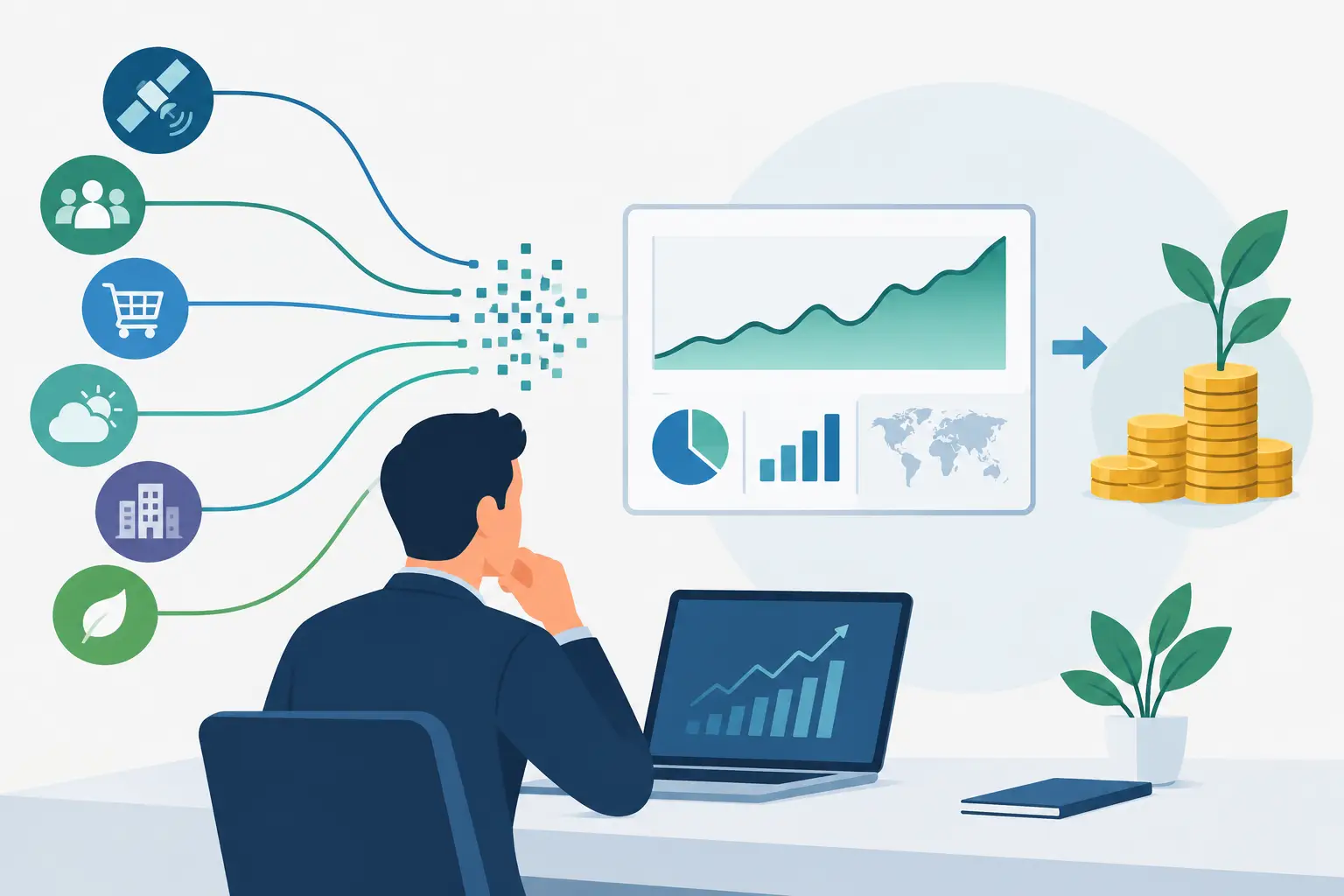
A quarterly earnings call can explain what happened. Alternative data can help an investment team form a view before the call begins. The distinction matters when consensus moves quickly, management guidance is incomplete, and traditional disclosures arrive after operational conditions have already changed.
For professional investors, the appeal is not novelty. It is informational timing. A well-governed data set may reveal shifts in consumer demand, supply-chain activity, hiring, pricing, web engagement, or physical traffic before those shifts appear in reported financials. But earlier signals are not automatically better signals. Without clear provenance, sound methodology, and disciplined interpretation, alternative data can create false confidence at institutional speed.
What Alternative Data Actually Means
Alternative data is information used in financial research that sits outside conventional company filings, earnings transcripts, price data, and standard market data feeds. It can be generated by businesses, collected from public sources, observed through commercial activity, or derived from digital and physical systems.
Common categories include transaction data, geolocation data, app and web activity, satellite imagery, job postings, product pricing, shipping records, patent filings, and aggregated consumer behavior. The categories matter less than the analytical question. A useful data source should help answer something specific: Is demand accelerating? Are inventory levels rising? Is a competitor gaining share? Is a company expanding capacity before the market expects it?
That framing separates research from data accumulation. A large collection of feeds does not create an information advantage on its own. In many cases, the most valuable source is not the one with the widest coverage. It is the one with a defensible relationship to the decision at hand.
Where Alternative Data Creates an Edge
The strongest use cases tend to appear where reported financial results lag operating reality. Consumer-facing businesses are an obvious example. Aggregated transaction patterns can offer a read on sales momentum, while location activity may provide context on store traffic and regional performance. Neither data set is equivalent to revenue, yet each can contribute to a more current operating view.
For industrials and transportation, shipment activity, port records, commodity flows, and satellite observations can inform a view on production, logistics, and capacity utilization. In software and internet sectors, web traffic, mobile engagement, search activity, and job listings may indicate product adoption, customer demand, or a change in investment priorities.
The edge is often found in the change, not the absolute number. A panel may be incomplete. A web metric may not represent all users. A geolocation provider may have uneven coverage by region or demographic. If those limitations are stable and understood, directional movement can still be highly informative. If they are not stable, an apparent signal may simply be a shift in collection methodology.
This is why a data source should be assessed as a measurement system, not merely a feed. Ask what it measures, what it misses, how often its methodology changes, and whether its history can be reconciled with known outcomes.
Signal Quality Is More Than Accuracy
Accuracy matters, but it is not the only standard. Timeliness, consistency, uniqueness, coverage, and revision behavior can matter just as much. A delayed data set may be accurate but commercially less useful. A broad data set may be statistically rich but too noisy for a single-name thesis. A highly differentiated source may be powerful, yet difficult to validate because there is little historical context.
Research teams should also distinguish correlation from economic relevance. A metric can correlate with quarterly results for several periods and still fail when consumer behavior, regulation, seasonality, or company strategy changes. The question is not simply whether a backtest works. The question is whether there is a credible reason the relationship should persist.
The Non-Negotiable Issue: Data Rights and Governance
Alternative data introduces a responsibility that cannot be delegated to a dashboard. Every source needs a clear answer to basic questions: Where did the data originate? Was it collected with appropriate notice and consent? What rights does the provider have to license it? Are there restrictions on storage, sharing, model training, or derivative use?
This is especially important for data connected to people, devices, payments, location, and digital behavior. Aggregation or anonymization may reduce privacy risk, but it does not remove the need for scrutiny. Re-identification risk, sensitive attributes, cross-border handling, and contractual use limitations still require attention.
A professional workflow should establish data lineage before a feed reaches broad distribution. Record the source, collection process, permissions, delivery method, transformations, known limitations, and approved uses. Maintain an owner who can answer questions when compliance, legal, or investment leadership asks how a conclusion was produced.
The same discipline applies to material nonpublic information. Alternative data is not inherently MNPI, but a research team should not assume that a novel source is safe simply because it is commercially available. Access controls, vendor diligence, escalation procedures, and written policies protect both the firm and the integrity of its investment process.
Turning Feeds Into Decision-Ready Research
The operational challenge is rarely access alone. It is converting fragmented inputs into a research process that supports a real decision under time pressure.
Start with a defined hypothesis and a measurable outcome. For example, an analyst may want to test whether a retailer's promotional intensity is likely to pressure gross margin, or whether job postings indicate a software company is entering a new product cycle. The hypothesis determines which source is relevant, what time window matters, and what would disprove the initial view.
Next, compare the alternative signal with primary materials and established market indicators. Company disclosures, regulatory filings, management commentary, channel checks, pricing data, and consensus estimates should not be treated as competitors to alternative data. They provide context. A traffic decline has a different implication if a company is closing stores, changing its loyalty program, shifting to delivery, or exiting a geography.
Then document the interpretation. Record the date of the observation, the source version, the transformation applied, the benchmark used, and the confidence level. This makes research reviewable and prevents teams from confusing a persuasive chart with a repeatable process.
A Financial Intelligence Portal can reduce the friction here by organizing approved sources, company context, alerts, and research outputs in one controlled workspace. The objective is not to automate conviction. It is to give analysts faster access to evidence while retaining accountability for the judgment that follows.
AI Changes the Workflow, Not the Standard
AI agents can monitor large volumes of updates, identify anomalies, compare company language across periods, and surface relationships that may deserve analyst attention. Those capabilities are useful because the alternative data universe is too broad for manual monitoring alone.
Yet an AI-generated observation should be treated as a research prompt, not a final investment conclusion. Models can misread a data dictionary, overstate a correlation, or rely on stale assumptions. They may also obscure the difference between sourced evidence and inferred interpretation if their outputs are not clearly structured.
The better operating model is human-led and machine-assisted. Assign agents bounded tasks, provide access only to approved data, preserve source citations within the workspace, and require review for material conclusions. Agent safety is not a feature added after deployment. It is part of the research architecture.
Security belongs in that architecture as well. Alternative data can be commercially sensitive even when it is legally obtained. Role-based permissions, authenticated access, controlled exports, audit trails, and clear retention rules help prevent useful intelligence from becoming unmanaged exposure.
What Often Goes Wrong
The most common failure is mistaking volume for insight. Teams subscribe to multiple feeds, build dashboards, and then struggle to explain which signal changed an investment decision. The result is cost, noise, and an expanding governance burden.
Another failure is overfitting. A source can appear predictive because researchers selected the time period, comparison group, or transformation after seeing the outcome. Predefining tests, tracking failed signals, and revisiting assumptions after structural changes can limit this problem.
There is also a practical sequencing issue. Smaller teams may gain more from a narrow, high-conviction use case than from an enterprise-wide data program. Start where reporting lags are meaningful and where the investment question is repeated often enough to justify process design. Expand only after the team can demonstrate that the signal is timely, interpretable, compliant, and economically useful.
The most durable advantage does not come from finding a secret feed. It comes from building a controlled system that can evaluate new information faster than the market without losing track of source quality, permissions, or analytical limits. That is the standard alternative data should meet before it enters the investment process.