
Calendar vs Threshold Rebalancing: Which and When
By MALI ·
Calendar rebalancing resets a portfolio to its target mix on a fixed schedule, such as every quarter or once a year, however far it has drifted. Threshold rebalancing checks the portfolio more often but trades only when an asset's weight moves outside a band around its target, such as five percentage points. Threshold rules trade less when markets are calm and react sooner when they move sharply; calendar rules are simpler to follow.
Neither rule is designed to raise returns. Rebalancing exists to keep the portfolio's risk close to what you chose. This article compares the two, as part of portfolio management for self-directed investors.
Why portfolios drift
Different assets earn different returns, so their weights change even if you never trade. A portfolio that starts at 60% stocks and 40% bonds becomes stock-heavy after a strong run in stocks, and riskier than you planned. Investor.gov's guide to asset allocation describes rebalancing as bringing the portfolio back to its original mix, because the mix you chose reflected your time horizon and risk tolerance. Leave it alone long enough and a portfolio that's mostly stocks can be carrying a risk you never signed up for.
The same guide describes both ways of deciding when: on a regular interval, such as every six or twelve months, or when an asset's weight moves by more than a percentage you set in advance. It adds that rebalancing tends to work best when done relatively infrequently, and that you should weigh transaction fees and tax consequences first.
The rules
Calendar rebalancing
Pick a date, such as the first trading day of the year, and trade back to the target then. It's easy to follow and easy to automate. The weakness is that the calendar ignores the market: it may trade when the drift is tiny, and it may sit still through a sharp move until the date comes round.
Threshold (band) rebalancing
Set a band for each asset, for example plus or minus five percentage points around its target. Check regularly, and trade only when a weight leaves its band. Some investors use relative bands instead, such as 25% of the target weight, so a 10% holding has a band of 7.5% to 12.5%.
Vanguard's 2024 research on target-date funds describes a variant with a separate "destination": when a 60/40 portfolio breaches a threshold of 2 percentage points, it rebalances to 1.75 points from target rather than all the way back. Trading to a point inside the band makes the trades smaller.
Hybrid
Check on a schedule (monthly or quarterly), but trade only if a weight has left its band. Many individual investors land here: it limits how often you look and how often you trade.
What the research says
Vanguard's December 2024 paper, The rebalancing edge, compared monthly, quarterly and threshold-based rebalancing for target-date funds. For a 60/40 portfolio, it found that its threshold-based method was expected to produce higher annual returns than the calendar approaches, because of lower transaction costs, and kept allocations closer to target over a year. In its March 2020 example, a monthly-rebalanced 60/40 portfolio could have drifted up to 7% from target and a quarterly one up to 10%, while the 200/175 threshold approach stayed within about 2%.
Two cautions. The paper studies professionally managed funds that monitor allocations daily and trade at institutional costs. And its estimated benefits are small: between about 5 and 25 basis points a year (a basis point is a hundredth of a percentage point), depending on the comparison and the stage of the fund. For an individual, taxes and the effort of checking often matter more than the choice of rule.
A worked example
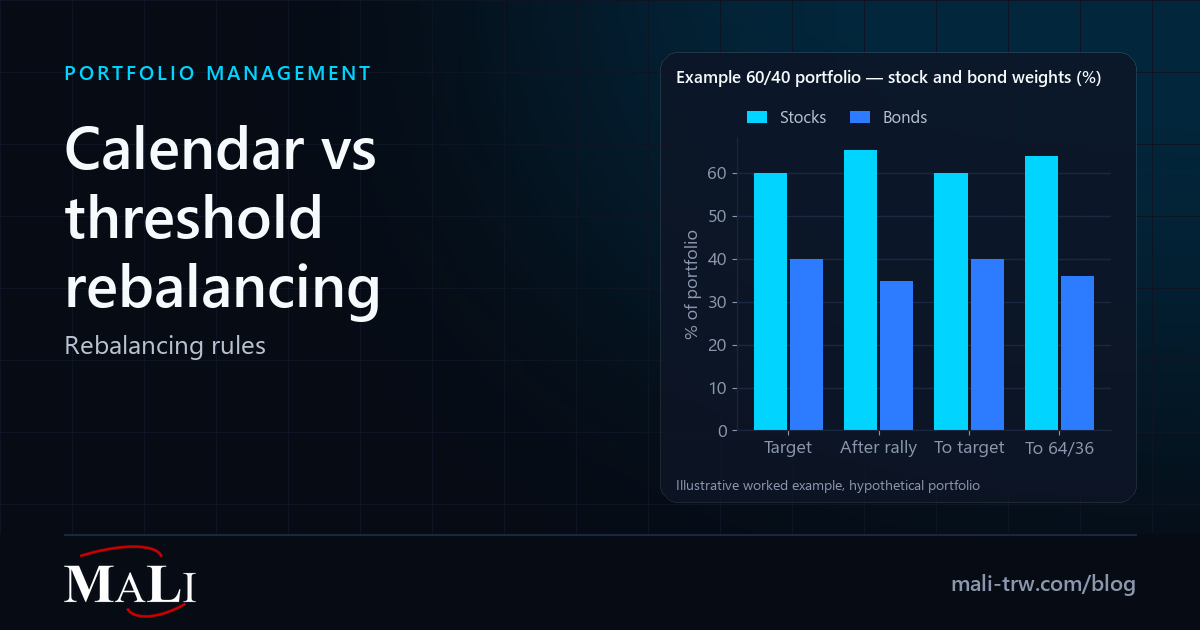
In this illustrative example, a hypothetical $100,000 portfolio targets 60% stocks and 40% bonds, with a band of plus or minus five percentage points.
Over the following months, stocks rise 25% and bonds are flat:
- Stocks: $60,000 × 1.25 = $75,000
- Bonds: $40,000
- Total: $115,000
- Stock weight: $75,000 / $115,000 = 65.2%
At 65.2%, stocks are outside the 55%–65% band, so a threshold rule trades. Three ways to respond:
- Back to target. 60% of $115,000 is $69,000. Sell $6,000 of stocks and buy $6,000 of bonds, ending at 60/40.
- Back to a destination inside the band. Rebalance to 64% stocks: 64% of $115,000 is $73,600. Sell $1,400 of stocks and buy $1,400 of bonds, ending at 64/36. The trade is less than a quarter the size.
- Rebalance with new money. Put new contributions into bonds only. To reach 60/40 without selling, bonds need to be $75,000 × 40/60 = $50,000, so a $10,000 contribution to bonds does it. Total: $125,000, stocks exactly 60%.
A calendar rule would have done nothing until its date. If stocks kept rising before then, the drift would have grown; if they fell back, the drift might have closed on its own.
Costs and taxes decide more than the rule
- Taxes. In a taxable account, selling the asset that has risen realizes a gain. Rebalancing inside tax-advantaged accounts, or with new contributions, avoids that. US investors should know the holding period (gains on assets held more than a year are long-term) and the wash sale rule if a rebalancing sale is at a loss; see the wash sale rule for active traders.
- Trading costs. Commissions are often zero now, but bid-ask spreads and fund transaction costs aren't.
- Cash flows. Dividends, interest, contributions and withdrawals are free rebalancing tools: direct them to the underweight asset.
- Lot choice. When you do sell in a taxable account, which lots you sell changes the tax. See Tax lots: FIFO vs specific identification.
Choosing a rule
| If you… | Consider |
|---|---|
| Want the simplest possible routine | Annual calendar rebalancing |
| Check your portfolio monthly anyway | Hybrid: monthly check, five-point bands |
| Hold large taxable gains | Bands plus new cash first; sell only when the band is breached |
| Hold volatile single stocks | Bands on each position as well as on asset classes |
Whatever you choose, write it down before markets move. The value of a rule is that it decides for you when the drift happens.
Where MALI fits
Portfolio Autopilot (Edge) works out a rebalancing plan toward one of five risk profiles, from conservative to aggressive growth and income. It compares each asset class with the profile's model weight and leaves a class alone when it's within 5 percentage points; a language model only describes the arithmetic. The Portfolio Advisor checks your largest position, sectors and top five against limits set by your risk tolerance, and its What-if view backcasts a proposed change over the past year.
Both advise only: neither places orders, and neither knows your tax situation.
FAQ
How often should I rebalance my portfolio?
There's no single right frequency. Many investors check monthly or quarterly and trade only when a weight leaves a band of around five percentage points, or rebalance once a year. Write the rule down and follow it.
What is a rebalancing band?
A range around each asset's target weight, such as 55% to 65% for a 60% target. You trade only when the weight moves outside it.
Does rebalancing improve returns?
That isn't its purpose. Rebalancing keeps risk close to the level you chose. Selling what has risen can lower returns in a long rally, and it can help when markets reverse.
Can I rebalance without selling?
Often, yes. Direct new contributions, dividends and interest to the underweight asset. In the example above, a $10,000 contribution to bonds brought a drifted 65/35 portfolio back to 60/40.
Should I rebalance individual stocks as well as asset classes?
If you hold single stocks, a band on each position helps stop one winner from quietly becoming a large share of the portfolio. The same trade-offs apply: taxes on gains in a taxable account, and the option of directing new money elsewhere instead of selling.
Sources
- Zhang, Ahluwalia, Daga and Zi, "The rebalancing edge: Optimizing target-date fund rebalancing through threshold-based strategies", Vanguard, 2024
- Beginners' Guide to Asset Allocation, Diversification, and Rebalancing, Investor.gov
- Publication 550 (2025), Investment Income and Expenses, IRS
This article is educational and is not investment advice. MALI is a research and analytics platform; it does not recommend buying or selling any security.