
Reading Form 4 Insider Buying: Codes, Plans, Signals
By MALI ·
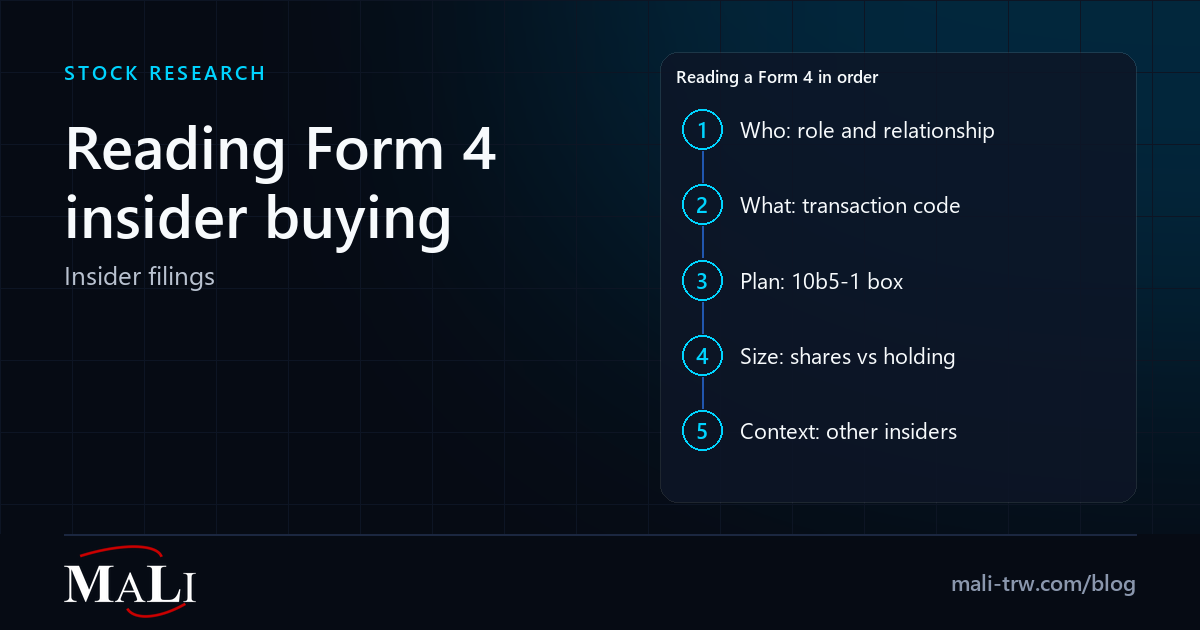
Form 4 is the filing a company's directors, officers and owners of more than 10% of its shares must make within two business days of buying or selling the company's stock. To read insider buying on a Form 4, look for transaction code P (an open-market or private purchase), check whether the trade was made under a pre-arranged 10b5-1 plan, compare the size of the purchase with what the insider already owns, and see whether other insiders bought around the same time.
Most Form 4 filings aren't purchases at all. Grants, option exercises, tax withholding and gifts all generate filings. Separating real buying from routine activity is most of the work. This guide is part of the process in how to research a stock.
Who files a Form 4, and when
Section 16 of the Securities Exchange Act covers a company's directors, its officers (such as the CEO, CFO and other executive officers) and beneficial owners of more than 10% of a registered class of its equity. These "insiders" file:
- Form 3 when they first become insiders, listing what they own.
- Form 4 within two business days of most changes in their holdings.
- Form 5 within 45 days after the company's fiscal year ends, for certain transactions that weren't reported on Form 4.
All three are public on SEC EDGAR, usually within minutes of filing.
The parts of a Form 4 that matter
Box 1 and Box 5: who and what role
The filer's name and relationship to the company: director, officer (with title), 10% owner, or other. A purchase by the CFO, who sees the numbers daily, reads differently from one by a 10% owner that is itself an investment fund.
Table I: the transaction code
Each row in Table I (non-derivative securities) carries a transaction code. The ones you'll see most:
| Code | Meaning | Usually informative? |
|---|---|---|
| P | Open-market or private purchase | Yes, the main signal |
| S | Open-market or private sale | Sometimes |
| A | Grant or award from the company | No, it's compensation |
| M | Exercise or conversion of a derivative, such as an option | Rarely on its own |
| F | Shares withheld to pay the exercise price or tax | No |
| G | Gift | No |
A purchase with code P means the insider spent their own money at the market price. That's why it gets the most attention.
The 10b5-1 checkbox
Since April 2023, Forms 4 and 5 include a checkbox to indicate that a transaction was made under a Rule 10b5-1 trading plan. These plans let insiders set up trades in advance, when they don't hold material non-public information, so the trades can execute later. The 2022 amendments to Rule 10b5-1 also introduced cooling-off periods before trading under a new plan can start: for directors and officers, the later of 90 days after adoption or two business days after the next 10-Q or 10-K, up to a maximum of 120 days.
A trade under a 10b5-1 plan was decided months earlier, so it tells you less about the insider's view today.
Columns 4 and 5: size and remaining holding
Table I shows the number of shares, the price, and the amount owned after the transaction. Compare the purchase with the holding afterwards. A director buying 2,000 shares and ending with 2,000 is making a first commitment. One buying 2,000 and ending with 400,000 has added half of one percent.
Direct or indirect ownership
Column 6 says whether the shares are held directly (D) or indirectly (I), for example through a trust, a family member or a fund. Indirect holdings are real ownership, but read the footnote to understand the vehicle.
Where to find Form 4 filings
Every Form 4 is on SEC EDGAR. Search the company, then filter the filing list by form type 4. Each filing shows the insider, the date and the transactions in a readable table, with the original XML alongside. EDGAR also lists filings by the insider's own name, which is useful when a director sits on several boards and you want to see their trades across companies. Many companies link recent insider filings from the investor relations section of their website as well.
What the research says
Academic studies have found that insider purchases carry more information than sales, and that the routine-versus-opportunistic distinction matters.
- Lakonishok and Lee (2001), studying US insider trades from 1975 to 1995, found that insider purchases were followed by abnormal returns while sales were not informative, and that the effect was concentrated in smaller companies.
- Cohen, Malloy and Pomorski (2012) separated "routine" insiders, who trade in the same month year after year, from "opportunistic" ones. In their sample, routine trades carried essentially no information, while opportunistic trades did.
These are historical findings across thousands of companies. They describe average tendencies, not what any single insider purchase means, and markets change as more investors read the same filings.
Reading insider buying well
- Filter for code P. Ignore grants, exercises, withholding and gifts unless you're studying compensation.
- Check the 10b5-1 box. Discount pre-arranged trades.
- Size it. Relative to the insider's holding, and if you can, relative to their annual pay disclosed in the proxy statement.
- Look for clusters. Several insiders buying within a few weeks is a stronger pattern than one.
- Check the timing. Purchases right after a large price fall, or soon after an earnings release when trading windows open, are common. Note them, but don't over-read them.
- Read sales with care. Insiders sell for taxes, diversification, house purchases and estate planning. A sale is rarely informative on its own, unless it is large, unplanned and coincides with sales by other insiders.
An illustrative example
Imagine three Form 4 filings at a hypothetical company within ten days after its share price fell 25% (the details are illustrative). The CEO bought 10,000 shares with code P, unchecked 10b5-1 box, raising their holding by 15%. Two directors also bought with code P. The same week, the general counsel filed a code F withholding.
The three purchases are the signal: open-market, not pre-planned, meaningful in size and clustered. The withholding is routine and tells you nothing. What the purchases don't tell you is whether the insiders are right. They're one input to your own research, not a conclusion.
Where MALI fits
MALI's event alerts include an insider-buying rule, so you can be notified when insiders buy at companies on your watchlist or in your portfolio, on Pro and Edge. The multi-agent debate (Edge) reads recent Form 4 insider trades and 8-K filings as part of the evidence its agents argue over, and lists the sources it was given.
Neither tells you whether a purchase matters. That judgment, using the checks above, stays with you.
FAQ
How soon after a trade is a Form 4 filed?
Within two business days of the transaction for most trades. The filing is public on SEC EDGAR as soon as it's accepted.
What does transaction code P mean on Form 4?
An open-market or private purchase of the company's securities. It's the code most investors look for, because it means the insider paid the market price with their own money.
Are insider sales a bad sign?
Not necessarily. Insiders sell for many personal reasons, and many sales are made under pre-arranged 10b5-1 plans or to cover taxes. Research has generally found sales less informative than purchases.
What is a 10b5-1 plan?
A written plan, set up when the insider doesn't have material non-public information, that schedules future trades. Since April 2023, Form 4 has a checkbox showing whether a trade was made under one.
Sources
- Forms 3, 4 and 5, Investor.gov (SEC)
- Insider Trading Arrangements and Related Disclosures (final rule, 2022), SEC
- Lakonishok and Lee, "Are Insider Trades Informative?", Review of Financial Studies, 2001
- Cohen, Malloy and Pomorski, "Decoding Inside Information", Journal of Finance, 2012
This article is educational and is not investment advice. MALI is a research and analytics platform; it does not recommend buying or selling any security.