
How to Read a 10-K: The Five Sections That Matter
By MALI ·
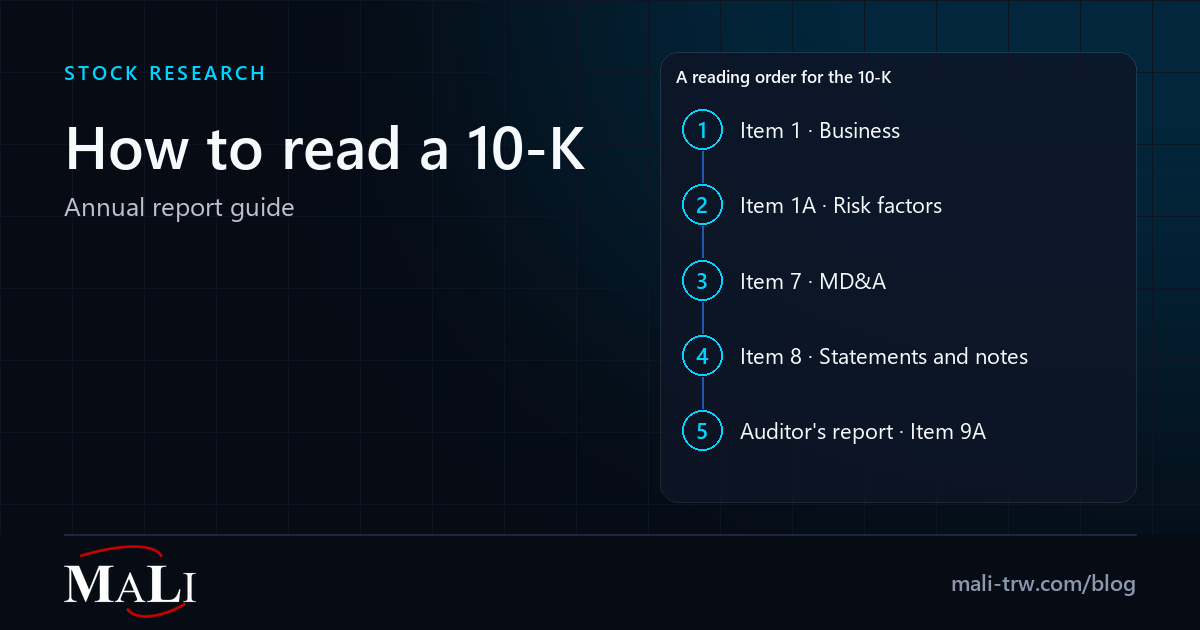
A 10-K is the annual report a US public company files with the SEC. It often runs past a hundred pages, but you don't need to read it cover to cover. Five parts carry most of what an investor needs: the business description (Item 1), the risk factors (Item 1A), management's discussion and analysis (Item 7), the financial statements and notes (Item 8), and the auditor's report with the controls section (Item 9A).
This guide explains what each one tells you, what to look for, and the warning signs that deserve a second read. It's one part of the wider process in how to research a stock.
What a 10-K is, and when it arrives
Every company with securities registered with the SEC files a Form 10-K once a year. Unlike the glossy annual report some companies mail to shareholders, the 10-K follows a fixed structure set by the SEC, so the same information sits under the same item number in every company's filing.
The deadline depends on the company's size. Large accelerated filers have 60 days after their fiscal year ends, accelerated filers 75 days, and everyone else 90 days. The financial statements in it are audited by an independent accounting firm, which is the main reason the 10-K is a more reliable source than a press release or an investor presentation.
1. Item 1: Business
Item 1 describes what the company does: its products and services, its markets, how it sells, its competition, its main suppliers, and how many people it employs. It is written by the company, so read it as the company's own account rather than an independent view.
What to look for:
- Who pays, and for what. You should be able to say in one sentence where the money comes from.
- Reportable segments. The company explains how it divides itself for reporting. Note the segment names, because the numbers for each appear later in the notes.
- Competition. Many companies name their main competitors here. If they don't, that is itself information.
- Seasonality and customers. Look for a statement that a single customer, or a few, account for a large share of sales.
A good test: if you can't explain the business to someone else after reading Item 1, read it again before you look at any numbers.
2. Item 1A: Risk factors
Item 1A lists the risks management considers material. Much of it is boilerplate written by lawyers to cover every possibility, so the skill is separating the generic from the specific.
Skip risks that would apply to any company ("we depend on key personnel", "economic conditions may affect demand"). Spend your time on:
- Risks that name things. A specific product, customer, supplier, regulator, patent, or country.
- New risks. Compare with last year's 10-K. A risk factor that appears for the first time, or moves near the top of the list, is worth noting. EDGAR keeps every prior filing, so the comparison takes a few minutes.
- Concentration. Dependence on a single supplier, a single factory, or a single licence.
Since fiscal years ending on or after 15 December 2023, companies also describe their cybersecurity risk management and governance in a separate Item 1C.
3. Item 7: Management's discussion and analysis (MD&A)
MD&A is where management explains the results in words: why revenue and margins moved, what drove cash flow, how the company funds itself, and what known trends or uncertainties could affect future results. It's the most useful section for understanding why the numbers changed.
What to look for:
- The explanation of each change. Does management attribute revenue growth to price, volume, acquisitions or currency? Each has different implications for next year.
- Liquidity and capital resources. How the company plans to meet its obligations, its credit lines, and any covenants.
- Critical accounting estimates. The judgments that most affect reported profit, such as revenue recognition timing, reserves, goodwill and pension assumptions.
- Known trends and uncertainties. The SEC requires management to discuss trends it reasonably expects to have a material effect. This is the closest the 10-K comes to an outlook.
Read MD&A with the financial statements open beside it, so you can check each explanation against the numbers.
4. Item 8: Financial statements and the notes
Item 8 contains the audited income statement, balance sheet, cash flow statement and statement of shareholders' equity, followed by the notes. The statements give you the totals. The notes tell you what's inside them.
The notes most investors return to:
- Revenue. How and when revenue is recognized, and its breakdown by product, region or customer type.
- Segments. Revenue and profit for each reportable segment.
- Debt. Interest rates, covenants, and a maturity schedule showing what falls due in each of the next five years.
- Leases and commitments. Obligations that may not look like debt but behave like it.
- Stock-based compensation. How much is paid in shares, which affects dilution.
- Income taxes. The effective tax rate and any unusual items.
- Contingencies. Lawsuits and other claims, with management's view of the likely outcome.
Start with the cash flow statement. It is harder to flatter than the income statement, and it shows how much cash the business actually produced and where it went.
5. The auditor's report and Item 9A
Two short items tell you whether the numbers deserve trust.
The auditor's report, at the start of Item 8, gives the auditor's opinion. A clean (unqualified) opinion is normal. Since 2019 for large accelerated filers, and since late 2020 for most others, the report also describes critical audit matters: the areas the auditor found most challenging, subjective or complex. They point straight to the judgments that most affect the numbers.
Item 9A, Controls and Procedures, says whether management concluded its internal control over financial reporting was effective. A disclosed material weakness means there is a reasonable possibility that a material misstatement wouldn't be prevented or caught in time. It isn't proof of a problem, but it is a reason to read the numbers more skeptically.
Red flags worth a second read
- A change of auditor, especially close to year end.
- A material weakness, or a restatement of earlier periods.
- Revenue growing much faster than cash from operations for several years.
- Receivables or inventory growing much faster than sales.
- Large, recurring "one-time" charges.
- New risk factors about customers, financing or regulators.
None of these proves anything is wrong. Each tells you where to look next.
Where MALI fits
MALI's SEC financials feature reads income statements, balance sheets and cash flows straight from the XBRL data in 10-K and 10-Q filings, up to ten years or twelve quarters back, and links each figure to the filing it came from. The public stock financials pages show the same for 108 large US companies; Apple's is one example.
They're a fast way to see the multi-year trends before you open the 10-K itself. They don't replace the filing: the notes, MD&A and risk factors are text, and companies that report in IFRS show as unavailable. To know when a new 10-K lands, set an event alert for the company's SEC filings.
FAQ
How long does it take to read a 10-K?
Reading the five sections above carefully takes one to two hours for most companies. A first pass that covers the business description, the cash flow statement and the newest risk factors can take 20 to 30 minutes.
What is the difference between a 10-K and an annual report?
The 10-K is the formal filing required by the SEC, with a fixed structure and audited financial statements. The "annual report to shareholders" is a separate document that companies may design themselves; some simply wrap the 10-K with a letter from the CEO.
Where do I find a company's 10-K?
On SEC EDGAR, by searching the company name or ticker and filtering for form type 10-K. Most companies also post it in the investor relations section of their website.
What is a critical audit matter?
It's a matter the auditor communicated to the audit committee that relates to material accounts or disclosures and involved especially challenging, subjective or complex auditor judgment. The auditor's report describes each one and how it was addressed.
Sources
- How to Read a 10-K, U.S. Securities and Exchange Commission
- Form 10-K, Investor.gov (SEC)
- AS 3101: The Auditor's Report on an Audit of Financial Statements, PCAOB
- Cybersecurity Risk Management, Strategy, Governance, and Incident Disclosure (final rule, 2023), SEC
This article is educational and is not investment advice. MALI is a research and analytics platform; it does not recommend buying or selling any security.