
News Sentiment in Stock Research, and Where It Misleads
By MALI ·
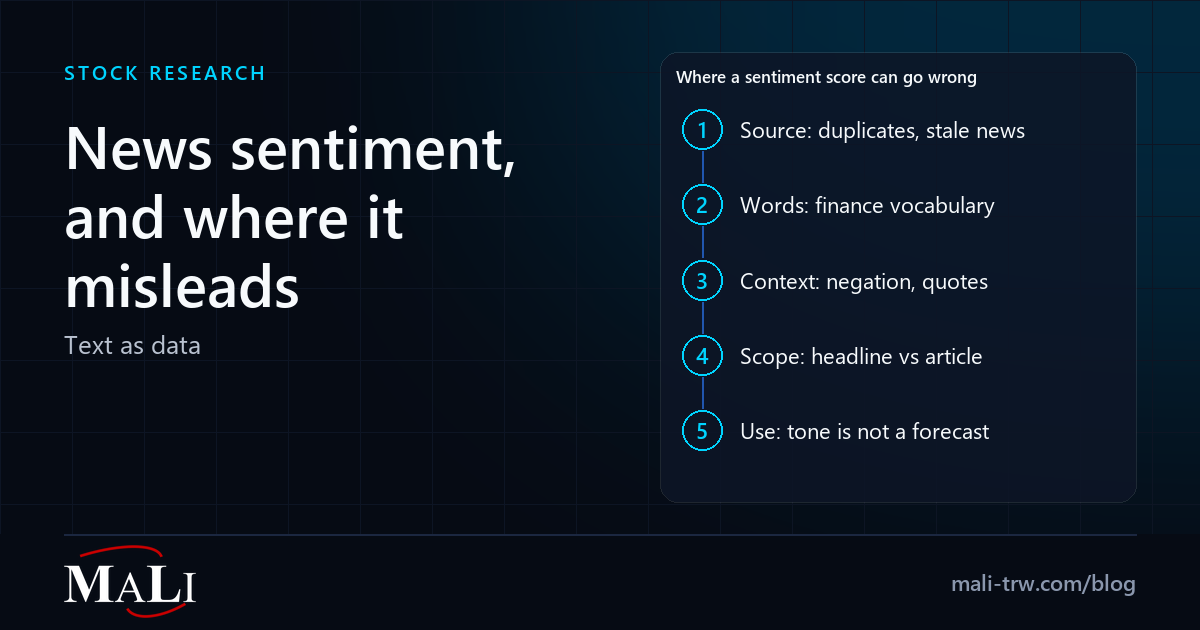
News sentiment analysis turns headlines and articles into a score for how positive or negative the coverage of a stock is. It's useful for seeing how coverage is shifting across many companies at once, and for spotting when tone and price disagree. It misleads when it counts repeated stories as new, uses general-purpose word lists that misread finance language, misses negation and context, or is treated as a forecast rather than a description.
This article explains how sentiment scores are built, what academic research has found, and seven failure modes to check before you rely on one. It's part of the process in how to research a stock.
How sentiment scores are built
There are two broad approaches.
Dictionary methods count words from lists of positive and negative terms. They're transparent and fast. Their weakness is the list itself: a word that's negative in everyday English may be neutral in a financial report.
Machine-learning models learn from labeled examples. FinBERT, published by Dogu Araci in 2019, is a version of the BERT language model further trained on financial text and fine-tuned to classify financial sentences as positive, negative or neutral. Models like this handle context better than word counts, but they're harder to inspect and can be confidently wrong on text unlike their training data.
Either way, the output is usually a score per headline or article, aggregated into an index per stock and day.
What the research says
- Tetlock (2007) measured the pessimism of a daily Wall Street Journal column and found that high media pessimism was followed by downward pressure on market prices that later reversed, and by unusually high or low trading volume.
- Loughran and McDonald (2011) showed that general-purpose dictionaries misclassify financial text. In their sample of 10-K filings, almost three quarters of the negative word counts from the widely used Harvard dictionary came from words that weren't typically negative in a financial context: words such as "tax", "cost", "liability" and "capital". They built finance-specific word lists that are now standard.
- Tetlock (2011) found that investors tend to overreact to stale news, stories that repeat information already published.
Two lessons follow. Sentiment measured carefully carries information about how investors react. And the measurement details, the vocabulary and the freshness of the news decide whether a score means anything.
Seven ways sentiment misleads
1. Stale and duplicated stories
The same story is often syndicated, rewritten and summarized across dozens of sites. A naive count scores each copy, so a single event looks like a wave of coverage. Good systems cluster near-duplicate stories and weight the first report.
2. Finance vocabulary
"Liability", "cost", "tax", "risk" and "vice" (as in vice president) are negative in a general dictionary and neutral in finance. A general model trained on product reviews or social media will misread them. Use finance-specific word lists or models trained on financial text.
3. Negation and hedging
"Not expected to miss guidance" contains "miss". "Losses narrowed" is good news that contains "losses". Simple word counts get both wrong. Models handle some negation, but hedged language ("may", "could", "subject to") still trips them.
4. Quotes and attribution
A headline that quotes an analyst's bearish view, or a company denying a rumor, carries the sentiment of the quote, not necessarily of the news. "CEO denies fraud allegations" scores as negative and may be the opposite.
5. Headline versus article
Headlines are written to be clicked. Scoring only headlines is fast but loses the detail, and the body of the article can change the meaning entirely.
6. Coverage bias
Large companies get far more coverage than small ones, so their indices are smoother and their extremes rarer. Comparing raw sentiment levels across companies of very different size is misleading; compare each stock against its own history.
7. Description, not forecast
A sentiment index tells you how coverage reads today. Research has found links between tone and later price behavior on average, across many stocks and many years, but that doesn't mean a negative score on one stock tells you its next move. Much of what a headline says is already in the price by the time it's scored.
Using sentiment well
- Look for divergence. Coverage turning negative while the price holds, or the reverse, is a prompt to read the stories and find out why.
- Read the extremes. Open the most strongly worded headlines. Often they're duplicates, quotes or misreadings, which tells you how much to trust the score.
- Compare with the stock's own history. A reading two standard deviations from its recent average is more interesting than a raw level.
- Check the source mix. A score driven by a single outlet or by press releases means something different from broad coverage.
- Keep it in its lane. Use sentiment to decide what to read, not what to buy.
Building your own check
You don't need a model to sanity-check a score. Take the twenty headlines that moved a stock's sentiment most in the last week, remove duplicates, and score them yourself as positive, negative or neutral for the company's business, not for the tone of the words. If your reading and the tool's disagree on more than a few, the tool isn't measuring what you care about for that company.
An illustrative example
Suppose a hypothetical company's sentiment index drops sharply overnight (the scenario is illustrative). Reading the top headlines shows that 30 of the 40 negative items are syndicated copies of one story about a lawsuit, and five more are articles quoting the company's denial. Only one original report adds new information. The index moved a lot; the information changed a little. The next step is to read the original report and the company's 8-K, if it files one.
Where MALI fits
MALI's news sentiment panel tracks a sentiment index for up to 20 tickers from headline tone and the day's move, flags divergence between sentiment and price, shows the most strongly worded headlines, and draws a band of two standard deviations around recent readings. Its Narrative Forecast view shows FinBERT's reading of recent headlines and scores each reading against the next five sessions' return. The panel states plainly that the index describes today and has not been shown to anticipate prices.
For the stories that matter, event alerts can notify you of company news and SEC filings on your watchlist, so you can go to the primary source.
FAQ
What is news sentiment analysis for stocks?
A method that scores news headlines or articles about a company as positive, negative or neutral, usually aggregated into a daily index. It describes the tone of coverage.
What is FinBERT?
A language model based on BERT, further trained on financial text and fine-tuned to classify financial sentences by sentiment. It was published by Dogu Araci in 2019.
Can news sentiment predict stock prices?
Academic studies have found average relationships between media tone and later market behavior, but that doesn't make a sentiment score a reliable forecast for any single stock. Treat it as a description of coverage and a prompt to read the underlying news.
Why do general sentiment tools misread financial news?
Because many words that are negative in everyday English, such as "liability", "tax" or "cost", are neutral in finance. Loughran and McDonald documented this in 10-K filings and built finance-specific word lists.
Sources
- Tetlock, "Giving Content to Investor Sentiment: The Role of Media in the Stock Market", Journal of Finance, 2007
- Loughran and McDonald, "When Is a Liability Not a Liability? Textual Analysis, Dictionaries, and 10-Ks", Journal of Finance, 2011
- Tetlock, "All the News That's Fit to Reprint: Do Investors React to Stale Information?", Review of Financial Studies, 2011
- Araci, "FinBERT: Financial Sentiment Analysis with Pre-trained Language Models", arXiv, 2019
This article is educational and is not investment advice. MALI is a research and analytics platform; it does not recommend buying or selling any security.