
How to Write a One-Page Bull/Bear Investment Thesis
By MALI ·
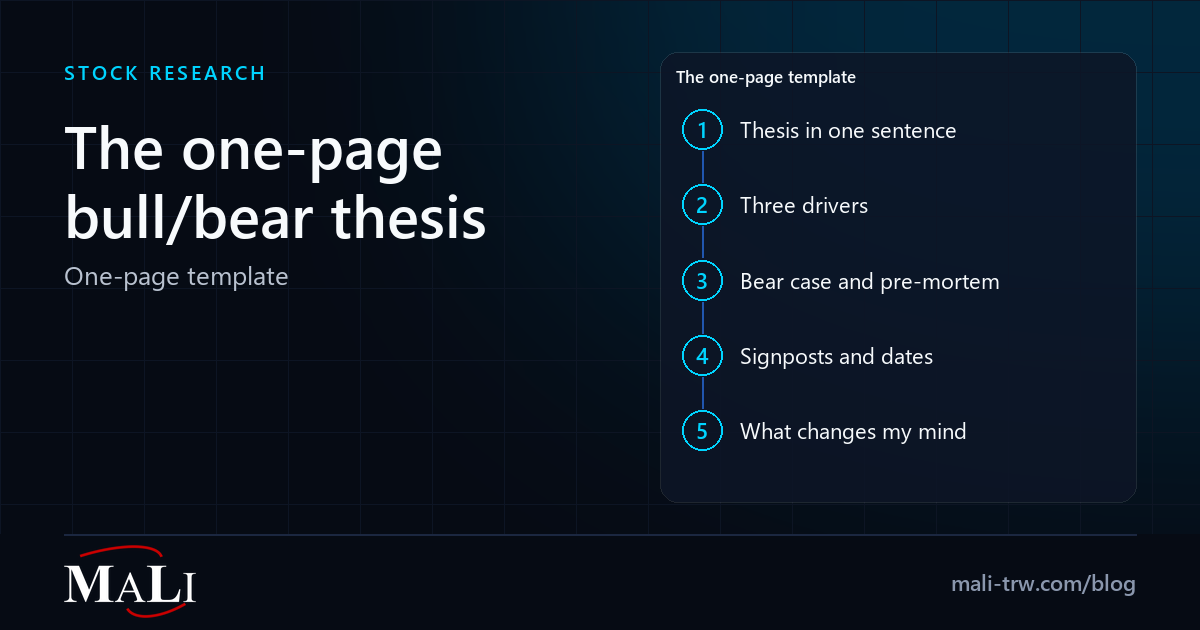
An investment thesis is a short, written argument for why a stock's future differs from what the price implies, with the evidence, the risks and the signposts that would show whether you're right. Keep it to one page: a one-sentence claim, the three drivers behind it, a bear case written as seriously as the bull case, measurable signposts with dates, and the specific conditions under which you'd change your mind.
Writing it down matters more than the format. A thesis in your head drifts to fit whatever happens next. A thesis on paper can be checked. This article gives a template and an example, as part of the process in how to research a stock.
Why one page
Long research documents are useful for building understanding, but they're hard to review. When a quarterly report lands, you want to check your view in five minutes, not reread twenty pages. One page forces you to decide what actually matters. If you can't fit the argument on a page, you probably haven't found its core yet.
The template
1. The thesis in one sentence
State what you believe and why the market might be wrong about it. A good thesis sentence is specific, has a time frame, and could turn out false.
- Weak: "This is a great company with strong management."
- Better: "Over the next two years, margins in the services segment will keep rising as the installed base grows, which the current valuation doesn't reflect because investors focus on falling hardware sales."
2. Three drivers
List the two or three things that have to be true for the thesis to work, each with the evidence you have now. Evidence means something you can point to: a trend in the filings, a disclosed contract, management's stated targets, industry data. Opinions go in a separate line, labeled as opinions.
3. The bear case
Write the strongest argument against your thesis, as if you had to present it. Then run a pre-mortem: imagine it's two years from now and the investment has gone badly; write down the most likely reasons why. The psychologist Gary Klein, who developed the technique, cites research finding that imagining an outcome has already happened increases people's ability to identify reasons for it by 30%.
If your bear case is weak, it usually means you haven't understood the risks, not that there aren't any.
4. Signposts with dates
Turn the drivers and risks into things you can observe:
- A metric and the direction you expect: "Services gross margin above 60% in the next two 10-Qs."
- An event and when it should happen: "New product revenue disclosed separately by the fiscal year-end 10-K."
- A risk indicator: "Customer concentration: no single customer above 15% of revenue."
Each signpost should be checkable from a filing, an earnings release or public data.
5. What would change my mind
Write down, in advance, the conditions under which you'd conclude the thesis is wrong. "Two consecutive quarters of falling services margin" is a condition. "If things get worse" is not. Deciding this before you see the outcome protects you from explaining away bad news afterwards.
6. Valuation and position notes
Add a line on what the price implies and the range of values you think is reasonable, and, if you own it, how large the position is and why. Keep the valuation as a range, not a single target, because the inputs are uncertain.
A worked example
Here is a one-page thesis for a hypothetical company, Example Co. (the company and figures are illustrative).
Thesis: Over the next two years, Example Co.'s services revenue will grow faster than hardware revenue falls, lifting group operating margin, which the market isn't pricing because headlines focus on hardware declines.
Drivers: 1. Services revenue grew 18% last year and is now 30% of the total (10-K segment note). 2. Services gross margin is about 30 points higher than hardware's (segment note). 3. Management targets services at 40% of revenue within three years (latest 10-K MD&A). Opinion: achievable if attach rates hold.
Bear case: Hardware sales fall faster than expected, shrinking the installed base that services depend on. A large competitor bundles a free alternative. Services growth is partly price increases that customers resist at renewal.
Pre-mortem reasons: Hardware decline accelerated; services churn rose after a price increase; management changed segment definitions, hiding the trend.
Signposts: Services growth above 12% in each of the next four quarters; services margin stable or rising; installed base disclosed and not shrinking; no segment recast without explanation.
What changes my mind: Services growth below 8% for two consecutive quarters, or a falling installed base.
Valuation: At the current price, a reverse DCF implies services growth of about 6% a year; my range of reasonable outcomes is 8% to 14%.
That fits on a page, and each quarter it takes five minutes to check.
Reviewing the thesis each quarter
When the company reports, go through the page line by line. Mark each signpost as on track, off track or not yet known, and note the evidence. If a driver is off track, decide whether the thesis still works without it. If a "what changes my mind" condition is met, act on it rather than looking for a reason to wait. Then add a dated line at the bottom with the outcome of the review. After a few quarters the page shows not just your view but how it held up, which is the most honest feedback an investor can get.
Common mistakes
- A thesis that can't be wrong. "Good company, good management" can't be tested. Add a claim about the future.
- Evidence that's really opinion. Separate what the filings show from what you believe.
- A token bear case. One line of risks is a sign you haven't argued against yourself.
- Moving the goalposts. Changing the "what changes my mind" line after bad news defeats its purpose. If you revise the thesis, date the new version and keep the old one.
Where MALI fits
MALI's multi-agent debate (Edge) is a useful way to stress-test a bear case. Six agents, Bull, Bear, Macro, Quant, Sentiment and Risk, argue the same evidence, cross-examine each other's weakest claims, and record dissent. Compare its strongest bear points with yours; if it raises a risk you missed, add it to the page. The debate is research output, not a thesis or a recommendation, and its verdict's numbers come from the agents' votes rather than a judgment about the future.
For the evidence lines, MALI's public stock financials pages link each figure to the filing it came from. For the signposts, event alerts can tell you when the next 10-Q or earnings release arrives.
FAQ
How long should an investment thesis be?
One page is enough for the working version you review each quarter. Your underlying research notes can be as long as you need.
What is the difference between a thesis and a price target?
A thesis is an argument about what will happen to the business and why the market may be mispricing it. A price target is a single number. A range of reasonable values reflects the uncertainty better than a single target.
What is a pre-mortem?
A technique developed by Gary Klein: before a decision, imagine it has already failed and write down the reasons. It brings out risks people tend to overlook when they're confident.
How often should I update my thesis?
Check it against the signposts each quarter, when the company reports. Rewrite it when a driver changes, and keep the dated previous version.
Sources
- Klein, "Performing a Project Premortem", Harvard Business Review, 2007
- Mitchell, Russo and Pennington, "Back to the Future: Temporal Perspective in the Explanation of Events", Journal of Behavioral Decision Making, 1989
- How to Read a 10-K, U.S. Securities and Exchange Commission
This article is educational and is not investment advice. MALI is a research and analytics platform; it does not recommend buying or selling any security.