
Position Sizing Methods: Fixed Fractional, Vol, Kelly
By MALI ·
Position sizing decides how much of your account goes into each trade or holding. The three common methods are fixed fractional (risk a fixed share of the account, such as 1%, between entry and stop), volatility targeting (scale the position so its expected swings match a target, holding less of volatile assets), and the Kelly criterion (size to maximize long-run growth given a known win rate and payoff). Fixed fractional controls the loss per trade, volatility targeting controls the swings, and Kelly is the most aggressive and the most sensitive to errors in your estimates.
This article works through all three with the same account, as part of portfolio management for self-directed investors. The numbers are illustrative; nothing here suggests any trade will win.
Fixed fractional sizing
Decide the share of the account you'll lose if the trade hits its stop. Then:
Shares = (account × risk %) / (entry price − stop price)
The position's dollar size falls out of that. A tight stop allows more shares; a wide stop, fewer. The loss at the stop stays the same share of the account whatever the stock.
Two cautions. A price can gap through a stop, especially overnight or at earnings, so the planned loss isn't a limit. And losing streaks compound: ten losses at 1% leave about 90.4% of the account (0.99^10), while ten at 5% leave about 59.9% (0.95^10).
Volatility targeting
Here you size by how much the asset tends to move rather than by a stop:
Weight = target volatility / asset's estimated volatility
If you want a holding to contribute swings of about 15% a year and the asset's volatility is 25%, hold 60% of the sleeve in it and the rest in cash. When its volatility rises, the weight falls. Volatility is estimated from recent returns, so the size changes as markets change, which means regular trades.
Research supports the idea that volatility and expected return don't move one for one. Alan Moreira and Tyler Muir (2017) found that portfolios taking less risk when volatility was high increased Sharpe ratios across a range of equity factors and the currency carry trade, in historical data. That's a finding about past samples, not a promise for any portfolio.
The Kelly criterion
John Kelly's 1956 paper, "A New Interpretation of Information Rate", showed how a gambler with an edge should size bets to maximize the long-run growth rate of wealth. For a bet that wins b times the stake with probability p and loses the stake with probability q = 1 − p:
Kelly fraction f* = p − q / b
For trading, read "the stake" as the amount you lose if the trade fails, the distance to your stop times the shares, and b as the ratio of your average win to your average loss. So f is the share of capital to put at risk, not the size of the position. If f comes out at zero or below, there's no edge to size.
Why traders use a fraction of Kelly
Kelly assumes you know p and b exactly. You don't: you estimate them from a limited and changing record. Leonard MacLean, Edward Thorp and William Ziemba (2010) set out the good and bad properties: Kelly maximizes long-run growth, but it can produce very large drawdowns along the way, and fractional Kelly trades some growth for much more security. Betting more than Kelly is worse on both counts: more risk and less growth.
A worked example
In this illustrative example, a hypothetical trader has a $50,000 account and a trade with entry at $40 and a stop at $36.
Fixed fractional at 1%. Risk = $50,000 × 1% = $500. Each share risks $40 − $36 = $4. Shares = $500 / $4 = 125. Position = 125 × $40 = $5,000, or 10% of the account.
Volatility targeting at 15%. If the stock's estimated volatility is 25% a year, the weight is 15% / 25% = 60%, a $30,000 position. If its volatility rises to 40%, the weight falls to 15% / 40% = 37.5%, or $18,750.
Kelly. Suppose the trader estimates a 55% win rate and an average win 1.5 times the average loss:
f* = 0.55 − 0.45 / 1.5 = 0.55 − 0.30 = 0.25
Full Kelly says put 25% of capital at risk: $12,500, twenty-five times the 1% rule. At $4 a share, that's 3,125 shares, a $125,000 position, two and a half times the account. Half Kelly (12.5%) still means risking $6,250.
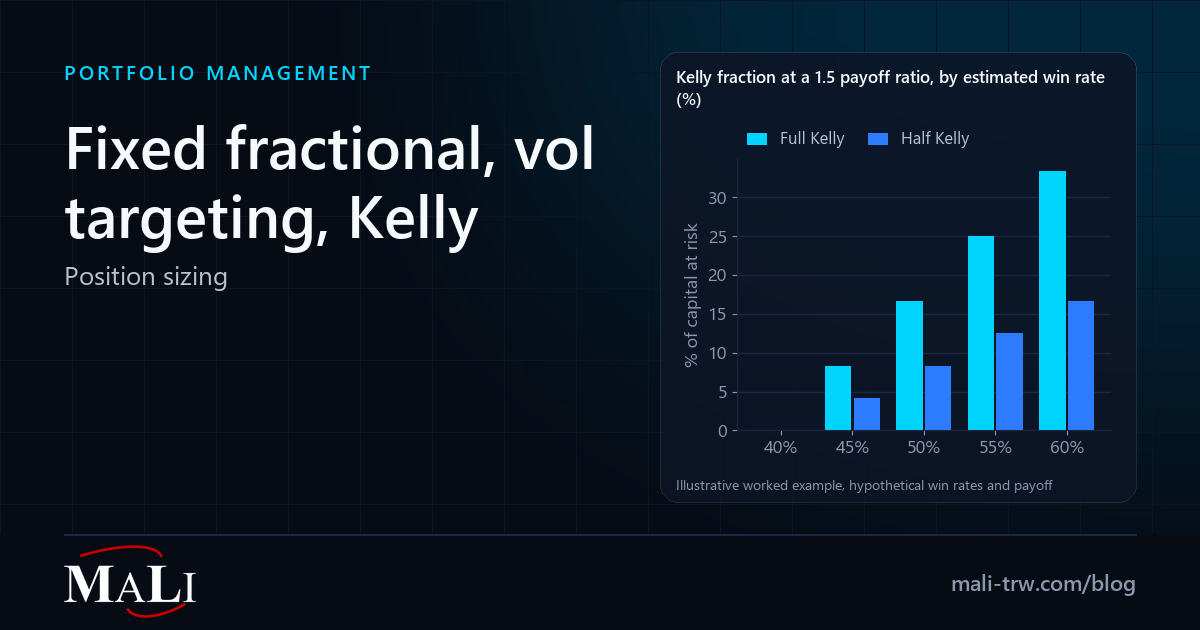
How sensitive is it? Keep the 1.5 payoff and change only the win rate estimate (the chart):
| Win rate | Full Kelly | Half Kelly |
|---|---|---|
| 40% | 0.0% | 0.0% |
| 45% | 8.3% | 4.2% |
| 50% | 16.7% | 8.3% |
| 55% | 25.0% | 12.5% |
| 60% | 33.3% | 16.7% |
A five-point error in the win rate moves full Kelly by more than eight points of capital at risk.
What the growth rate does. Kelly maximizes the expected log growth per trade, g(f) = p × ln(1 + b × f) + q × ln(1 − f). At p = 0.55 and b = 1.5:
- Full Kelly (f = 0.25): g = 0.55 × ln(1.375) + 0.45 × ln(0.75) = 0.1752 − 0.1295 = 0.0457 per trade.
- Half Kelly (f = 0.125): g = 0.55 × ln(1.1875) + 0.45 × ln(0.875) = 0.0945 − 0.0601 = 0.0344, about 75% of the full Kelly growth for half the risk.
- Double Kelly (f = 0.50): g = 0.55 × ln(1.75) + 0.45 × ln(0.5) = 0.3078 − 0.3119 = −0.0041. Twice Kelly shrinks wealth in the long run despite the edge.
And if the true win rate is 50% while the trader bets the 25% sized for 55%, growth falls to 0.0154 per trade, below the 0.0204 that the correct Kelly fraction (16.7%) would give.
Choosing a method
| Method | Controls | Main risk |
|---|---|---|
| Fixed fractional | Loss per trade at the stop | Gaps through stops; many correlated positions at once |
| Volatility targeting | Expected swings | Volatility estimates lag sudden moves |
| Kelly (fractional) | Long-run growth for a known edge | The edge is estimated, and errors push you over-size |
Many traders combine them: fixed fractional for each trade, a cap on total risk across open trades, and Kelly only as a ceiling.
Where MALI fits
The free position size calculator does the fixed-fractional arithmetic from account size, risk per trade, entry and stop, and a second panel gives the full and half Kelly fractions for the win rate and payoff you enter. It tells you when the figures show no edge. The Portfolio Advisor checks the result against limits for your largest position, sectors and volatility.
MALI's Backtesting Lab (Pro) can size its built-in strategies as a fixed share of capital, by Kelly, or to a 15% annual volatility target. Its results are historical and average the tickers tested; they don't show that any sizing will work going forward.
FAQ
What is the best position sizing method?
There isn't one best method. Fixed fractional is the simplest way to cap the loss per trade. Volatility targeting keeps swings steadier. Kelly needs a reliable estimate of your edge, which few traders have, so most use a fraction of it or none.
What does the Kelly fraction mean for a stock trade?
In the betting formula, you lose the whole stake on a loss. For a trade with a stop, the stake is the amount lost at the stop, so the Kelly fraction is the share of capital to put at risk, not the position size.
Why use half Kelly?
Because the win rate and payoff are estimates. In the example, half Kelly kept about 75% of full Kelly's growth rate with half the capital at risk, and it leaves room for the estimates to be wrong.
How much should I risk per trade?
That's a personal choice that depends on your account, goals and tolerance for losing streaks. Many traders choose a small fixed share; in the example, ten straight losses at 1% each leave about 90% of the account.
Sources
- Kelly, "A New Interpretation of Information Rate", Bell System Technical Journal, 1956
- MacLean, Thorp and Ziemba, "Long-term capital growth: the good and bad properties of the Kelly and fractional Kelly capital growth criteria", Quantitative Finance, 2010
- Moreira and Muir, "Volatility-Managed Portfolios", Journal of Finance, 2017
This article is educational and is not investment advice. MALI is a research and analytics platform; it does not recommend buying or selling any security.