
Stock Research Checklist: 12 Steps in 30 Minutes
By MALI ·
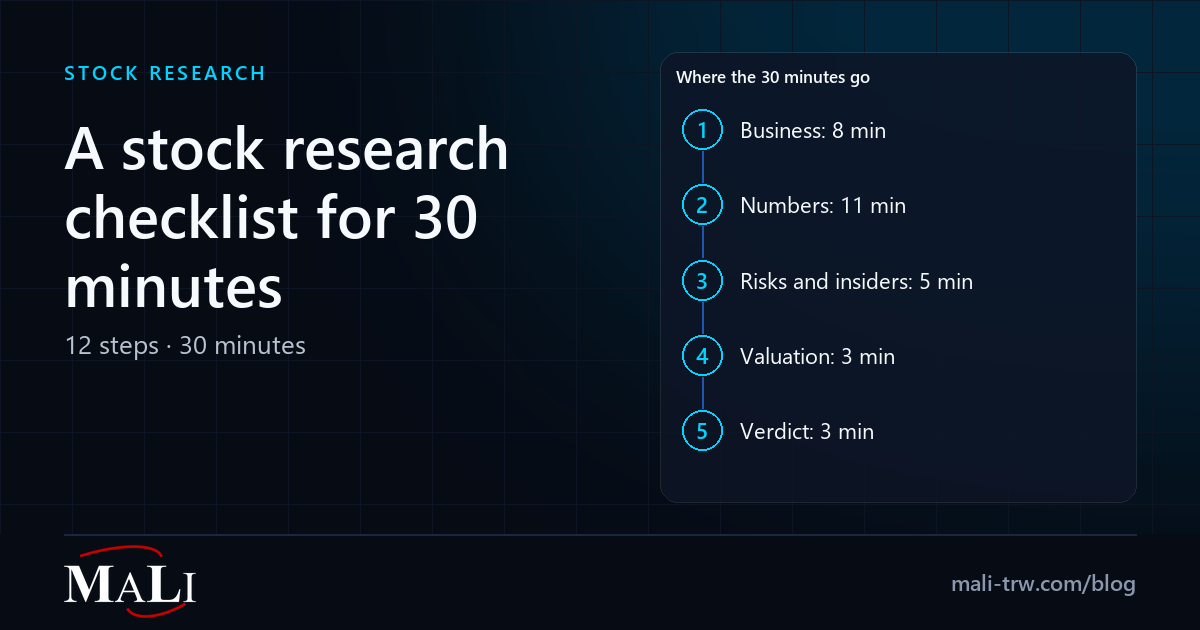
You can research a stock well enough to decide whether it deserves a deeper look in about 30 minutes. The trick is to read in a fixed order: what the company does, how it makes money, whether profits turn into cash, what could break it, and roughly what the price already assumes. Everything below uses free primary sources, mainly the company's own SEC filings.
This checklist is a first pass, not a full due-diligence process. Its job is to sort ideas into three piles: drop, watch, or research properly. For the full process, see the guide on how to research a stock.
Before you start: set a timer and a question
Write one sentence on why this stock is on your screen. "A friend mentioned it" and "it fell 30% this week" are both honest answers, and they lead to different questions. A stock you found because it dropped needs a check on what changed. A stock you found on a screen needs a check on whether the screen's numbers mean what you think.
Then open three things: the latest annual report (Form 10-K), the latest quarterly report (Form 10-Q), and the company's filing list on SEC EDGAR. Every US-listed company files these, and they are free.
The 12-step checklist
Business (8 minutes)
- Describe the business in one sentence (3 min). Read the first pages of Item 1, "Business", in the 10-K. If you can't say who pays the company and for what, stop here and come back when you can.
- Find out where revenue comes from (3 min). Look for the segment note in the financial statements and the revenue breakdown by product or region. A company that looks diversified sometimes earns most of its profit from one segment.
- Note the customers and the competition (2 min). Item 1 usually names major competitors. The notes disclose customer concentration when a single customer is a large share of revenue.
Numbers (11 minutes)
- Revenue and operating margin over five years (3 min). You want the direction and the consistency, not the decimal places. Steady growth with a stable margin reads differently from a margin that jumps around.
- Free cash flow against net income (3 min). Free cash flow is usually operating cash flow minus capital expenditure. If net income keeps rising while free cash flow doesn't, find out why before you trust the earnings.
- Debt and when it's due (3 min). Compare total debt with cash, and read the debt maturity table in the notes. A big maturity in the next two years matters more when rates are higher than when the debt was issued.
- The share count (2 min). Compare diluted shares outstanding now with three to five years ago. A falling count means buybacks; a rising one means stock compensation or acquisitions paid in shares are diluting you.
Risks and insiders (5 minutes)
- Read the risk factors that are specific (3 min). Item 1A is long and much of it is boilerplate. Skim for risks that name this company's products, customers, suppliers or lawsuits, and for anything new since last year.
- Check insider transactions (2 min). Form 4 filings show when directors and officers buy or sell. Open-market purchases (transaction code P) say more than sales, which happen for many reasons, including taxes and diversification.
Valuation (3 minutes)
- One rough valuation check (3 min). Pick a single measure that suits the business, such as price to free cash flow or enterprise value to operating income, and compare it with the company's own history and two or three close peers. You aren't valuing the company yet. You're asking whether the price needs a lot to go right.
Verdict (3 minutes)
- Write the bear case first (2 min). Three sentences on how an investor could lose money here. If you can't write them, you don't understand the risks yet.
- Decide the next step (1 min). Drop it, add it to a watchlist with a reason and a trigger, or schedule a proper research session. Write the decision down with the date.
A worked example
Take a hypothetical company, Example Co. (the figures are illustrative, not a real company's). Over five years its net income rose from $40 million to $66 million. That looks like steady progress.
Step 5 changes the picture. Free cash flow over the same years was $38 million, $30 million, $41 million, $35 million and $44 million. Cash generation barely grew while reported profit rose by two thirds. The cash flow statement shows why: receivables grew faster than revenue each year, so more of each year's sales were booked as profit before the cash arrived.
That doesn't make Example Co. a bad business. It does change the next question from "is it cheap?" to "why are customers paying more slowly, and is that likely to reverse?" A 30-minute pass is meant to produce exactly that kind of question.
Common mistakes on a first pass
- Starting with the share price chart. The chart tells you what happened to the price, not why. Read the business first so the chart has context.
- Trusting a single year. One strong year can come from an asset sale, a tax benefit or a one-off contract. Five years of the same line is a better guide.
- Reading adjusted figures before reported ones. Press releases often lead with adjusted earnings. Start from the GAAP numbers in the filing, then look at what the adjustments remove.
- Skipping the notes. Segment data, debt maturities, lease commitments and stock compensation live in the notes, not on the face of the statements.
- Letting the verdict drift. If you don't write a decision down, the stock tends to stay in your head as "interesting" for months.
When 30 minutes isn't enough
Some companies don't fit a quick checklist. Banks and insurers need different measures, because debt is part of their business model rather than a financing choice. Early-stage companies with little revenue have few years of numbers to compare. Companies that just completed a large acquisition have results that aren't comparable year to year. For those, use this list to collect questions, not to reach a verdict.
Where MALI fits
MALI's stock financials pages cover 108 large US companies, with income statements, balance sheets and cash flows read from their SEC filings. Each figure links to the filing it came from, and derived figures such as free cash flow are marked. For example, Microsoft's statements show up to ten fiscal years and twelve quarters, which covers steps 4 to 7.
For finding ideas, the plain-English stock screener shows how it read your request before it lists matches, though it covers 67 large US stocks, not the whole market. To keep step 12 from going stale, event alerts can tell you when a company on your watchlist files a 10-Q, 10-K or 8-K, or reports earnings.
FAQ
How long should it take to research a stock?
A first pass that decides whether a stock deserves more time can take about 30 minutes. A full research process, including a valuation model and a written thesis, usually takes several hours spread over days, so you can come back to it with fresh eyes.
What is the most important part of a 10-K for a quick review?
Item 1 (Business) tells you what the company does, and the cash flow statement in Item 8 tells you whether its profits turn into cash. If you only have ten minutes, read those two.
Where can I find a company's SEC filings for free?
On SEC EDGAR. Search the company's name or ticker and you'll see every filing, including the 10-K, 10-Q, 8-K and insider Forms 4. Most companies also link their filings from the investor relations section of their website.
Should I look at analyst ratings during a first pass?
They can tell you what the market expects, but they aren't a substitute for reading the filings. Read the company's own numbers first, so you can judge whether the consensus view makes sense.
Sources
- How to Read a 10-K, U.S. Securities and Exchange Commission
- Using EDGAR to Research Investments, Investor.gov (SEC)
- EDGAR full-text and company search, SEC
- Forms 3, 4 and 5, Investor.gov (SEC)
This article is educational and is not investment advice. MALI is a research and analytics platform; it does not recommend buying or selling any security.