
How Splits and Spin-Offs Change Cost Basis
By MALI ·
A stock split doesn't change your total cost basis: it spreads the same basis across more shares (or fewer, in a reverse split), so the basis per share changes. A tax-free spin-off moves part of your basis from the parent company's shares to the new company's shares, in the proportion the parent reports, usually on IRS Form 8937. In both cases your holding period carries over to the shares you receive.
This article covers US federal income tax rules for individual investors. It's educational, not tax advice. It's part of portfolio management for self-directed investors.
Stock splits
Forward splits
IRS Publication 550 says to figure the basis of a stock split the same way as a nontaxable stock dividend of identical stock: divide the adjusted basis of the old shares by the total number of old and new shares. Publication 550's own example: one share bought for $45, followed by a distribution of two new shares for each share held, gives three shares with a basis of $15 each.
If you bought shares in several lots, the split applies lot by lot. Each lot keeps its own date and total basis; only the share count and basis per share change. A lot of 100 shares at $90 becomes, after a 3-for-1 split, a lot of 300 shares at $30.
Reverse splits
A reverse split works the other way: fewer shares, higher basis per share, same total. In a 1-for-10 reverse split, 300 shares with a $6,000 basis ($20 a share) become 30 shares at $200 each.
Fractional shares
A split or spin-off ratio often leaves fractions. Companies usually sell the fractions and pay cash. Publication 550 says cash you receive for fractional shares under such a plan is treated as an amount realized on the sale of the fractional shares, reported on Form 8949. You'll have a small gain or loss, using the basis that belongs to the fraction.
Holding period
Publication 550: the holding period for new stock received as a nontaxable stock dividend begins on the same day as the holding period of the old stock. Shares received in a split don't restart the clock.
Spin-offs
In a spin-off, a company distributes shares of a subsidiary to its shareholders. When it qualifies as tax-free, you don't recognize gain or loss when you receive the new shares. Instead, you divide your existing basis between the old and new shares.
How the allocation works
Publication 550's rule for new stock that isn't identical to the old: divide the adjusted basis of the old stock between the old and new stock in the ratio of the fair market value of each to the total fair market value of both on the date of distribution. In practice, the company tells you the percentage.
Publication 550's spin-off example: an investor holds 75 shares of one company with a basis of $5,400 and receives 25 shares of the spun-off company. The company reports that the new shares' basis equals 10.9624% of the old basis, so the new shares get $592 and the old shares keep $4,808.
Form 8937
Form 8937, Report of Organizational Actions Affecting Basis of Securities, is how issuers report the effect of actions such as spin-offs on their holders' basis. Under the Instructions for Form 8937, the issuer files it with the IRS by the 45th day after the action or, if earlier, 15 January of the following year. It doesn't have to file with the IRS if it posts the completed form on its public website by the due date, and it must keep it accessible there for 10 years. Look for it in the investor relations section, often under "tax information".
The form describes the action, its date, and how basis is affected, usually as the percentage of the old basis to allocate to each security. It also says which Internal Revenue Code sections the company relies on, such as section 355 for a tax-free spin-off. Read the form for the specific action rather than assuming.
Holding period
Publication 550 says the rule that new shares share the old shares' holding period also applies to stock acquired in a spin-off. If your parent shares were long-term, the spun-off shares are too.
A worked example
In this illustrative example, an investor owns shares of a hypothetical company, Example Co., in one lot. The ratios and percentages are made up for the example.
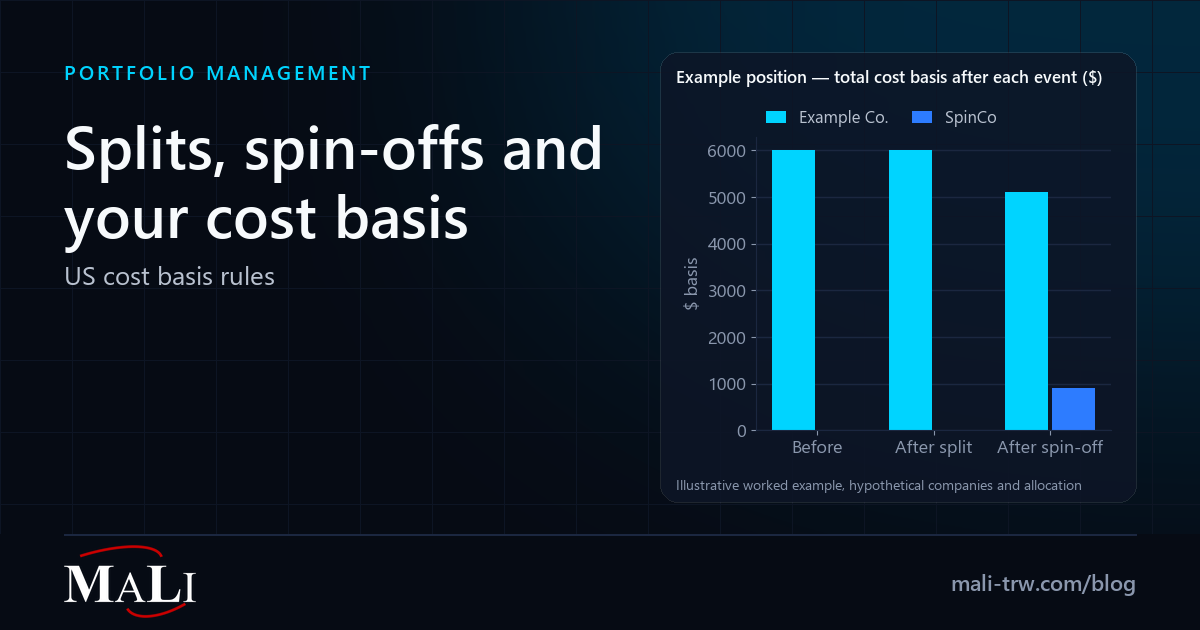
Start. 100 shares bought for $6,000, or $60 a share.
3-for-1 split. The investor now holds 300 shares. Total basis is still $6,000; basis per share is $6,000 / 300 = $20.
Spin-off. Example Co. distributes 1 share of SpinCo for every 4 Example Co. shares, so the investor receives 300 / 4 = 75 SpinCo shares. Example Co.'s Form 8937 says to allocate 85% of the pre-distribution basis to Example Co. and 15% to SpinCo:
- Example Co.: $6,000 × 85% = $5,100, or $5,100 / 300 = $17.00 a share.
- SpinCo: $6,000 × 15% = $900, or $900 / 75 = $12.00 a share.
Total basis is still $6,000 (the chart). Both holdings keep the original purchase date for the holding period.
A later sale. If the investor sells all 75 SpinCo shares at $15, the gain is 75 × ($15 − $12) = $225. Without the allocation, a tracker might show SpinCo with zero basis and a $1,125 gain, and Example Co. with $900 too much basis, overstating one gain and understating another.
Checking your records
- Compare share counts after every corporate action with what the broker shows. A mismatch usually means a split wasn't applied, or was applied twice.
- Find the Form 8937 for each spin-off and record the allocation percentage and date.
- Apply it lot by lot if you bought the parent in several lots: each lot gives part of its basis to the new shares received on it.
- Keep the issuer's information. Publication 550 advises keeping it until the period of limitations expires for the year you sell the shares in a taxable disposition.
- Reconcile with Form 1099-B. For covered shares, brokers adjust basis for corporate actions, but they can get it wrong or lack the data for older, noncovered lots. See Import brokerage history and get true cost basis.
Where MALI fits
MALI's portfolio tracker applies splits that appear in an imported brokerage file to the earlier purchases. For a split the file doesn't carry, or for a spin-off, you record it yourself, entering the cost split from the company's Form 8937; spin-offs aren't imported. The resulting lots feed the tax-loss harvest view, which marks long-term lots and possible wash sales. Tax views are estimates, not tax advice.
The Portfolio Advisor then checks the holdings you end up with, including the new company's weight, against its concentration and sector limits.
FAQ
Does a stock split change my cost basis?
Your total basis stays the same. The basis per share changes because the same total is spread across a different number of shares. Each lot keeps its own purchase date.
How do I find the cost basis of spin-off shares?
Look for the parent company's Form 8937, usually on its investor relations website. It gives the percentage of your original basis to allocate to the new shares. Multiply your basis in the parent shares by that percentage.
Is a spin-off taxable?
Many spin-offs are structured to be tax-free under section 355, so receiving the shares isn't taxed and your basis is divided instead. Not all are; the company's Form 8937 says how it treats the distribution.
What happens to cash paid for fractional shares?
Publication 550 treats cash received for fractional shares as proceeds from selling the fraction. You report a small gain or loss on Form 8949, using the basis that belongs to the fractional share.
Sources
- Publication 550 (2025), Investment Income and Expenses, IRS
- Instructions for Form 8937, IRS
- About Form 8937, Report of Organizational Actions Affecting Basis of Securities, IRS
- Topic no. 703, Basis of assets, IRS
This article is educational and is not investment advice. MALI is a research and analytics platform; it does not recommend buying or selling any security.