
Time-Weighted vs Money-Weighted Return, Worked Out
By MALI ·
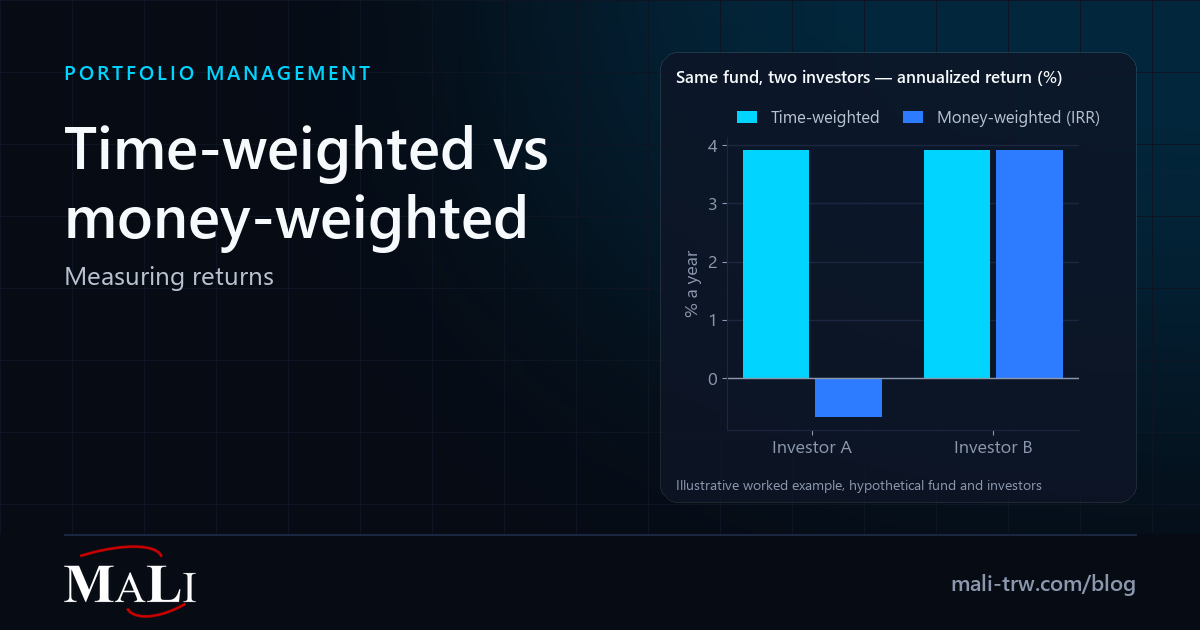
Time-weighted return (TWR) measures how the investments performed, with the effect of your deposits and withdrawals removed. Money-weighted return (MWR), the internal rate of return on your cash flows, measures how your money actually did, including when you added or took it out. They match when there are no cash flows, and they can differ a lot when large deposits or withdrawals come just before a strong or weak stretch.
Use TWR to compare a portfolio or manager with an index. Use MWR to see what your own timing and saving pattern produced. This article works both out by hand, as part of portfolio management for self-directed investors.
The two definitions
Time-weighted return
Split the period at every external cash flow. Work out the return of each sub-period from the value just before a flow to the value just before the next one. Then link the sub-period returns by multiplying the growth factors:
TWR = (1 + r1) × (1 + r2) × … × (1 + rn) − 1
Because each sub-period starts fresh, the size of the account in that sub-period doesn't matter. A deposit before a bad month doesn't drag TWR down any more than the same month would have with no deposit.
The cost is data: you need a valuation on every date money moves in or out. With daily values, that's easy. With only month-end statements, you approximate.
Money-weighted return
MWR is the single rate r that makes the present value of all your cash flows, including the ending value, equal zero. In practice: the rate at which your deposits, grown for the time each was invested, add up to the ending value. Spreadsheet functions such as IRR (regular periods) and XIRR (exact dates) solve it.
A large deposit gets more weight because more money was exposed to the returns that followed. That's the point: MWR answers "what did my money earn?"
Why the industry standard uses TWR
The CFA Institute's Global Investment Performance Standards (GIPS) require firms to present time-weighted returns unless specific conditions are met. Provision 1.A.35 allows money-weighted returns only when the firm controls the external cash flows and the portfolios have at least one of these features: closed-end, fixed life, fixed commitment, or illiquid investments as a significant part of the strategy. That describes many private-market funds.
The GIPS handbook gives the reason: external cash flows are generally client-driven, so managers shouldn't be rewarded or penalized for decisions outside their control. By removing those flows, TWR best reflects how the portfolio was managed. For you as a self-directed investor, both decisions are yours, which is why it's worth computing both.
A worked example
This is an illustrative example with a hypothetical fund and two hypothetical investors. The fund returns +20% in year 1 and −10% in year 2.
Time-weighted return (the same for both)
TWR = (1 + 0.20) × (1 − 0.10) − 1 = 1.20 × 0.90 − 1 = 1.08 − 1 = 8.0% over two years.
Annualized: 1.08^(1/2) − 1 = 1.0392 − 1 = 3.92% a year.
TWR depends only on the fund's returns, so it's the same whatever either investor deposits.
Investor B: $20,000 at the start, nothing after
- After year 1: $20,000 × 1.20 = $24,000.
- After year 2: $24,000 × 0.90 = $21,600.
With no cash flows after the start, MWR equals TWR: $20,000 × (1 + r)² = $21,600, so (1 + r)² = 1.08 and r = 3.92% a year.
Investor A: $10,000 at the start, $10,000 more after year 1
- After year 1: $10,000 × 1.20 = $12,000.
- Deposit: $12,000 + $10,000 = $22,000.
- After year 2: $22,000 × 0.90 = $19,800.
Investor A put in $20,000 and ended with $19,800. To find MWR, solve for the rate r that grows both deposits to the ending value:
$10,000 × (1 + r)² + $10,000 × (1 + r) = $19,800
Divide by $10,000 and write x = 1 + r:
x² + x − 1.98 = 0
Using the quadratic formula, x = (−1 + √(1 + 4 × 1.98)) / 2 = (−1 + √8.92) / 2 = (−1 + 2.98664) / 2 = 0.99332.
So r = 0.99332 − 1 = −0.67% a year.
Same fund, same years, same 3.92% time-weighted return. Investor A's money lost value because half of it arrived just before the bad year.
A quick approximation
The modified Dietz method approximates a period's money-weighted return by weighting each flow by the share of the period it was invested:
(ending value − starting value − net flows) / (starting value + weighted flows)
For Investor A over two years, the deposit was invested for half the period: ($19,800 − $10,000 − $10,000) / ($10,000 + 0.5 × $10,000) = −$200 / $15,000 = −1.33% over two years, close to −0.67% a year. It's useful when you don't have a spreadsheet to hand, and it gets less accurate when returns are large.
What the research says about the gap
Ilia Dichev's 2007 study in the American Economic Review compared dollar-weighted (money-weighted) returns with buy-and-hold returns on stock market indices. It found that actual investor returns were systematically lower than buy-and-hold returns in nearly all major international stock markets, and it traced the gap to the timing and size of investors' money flowing into and out of the market. That's a statement about investors on average, not about you, but it's a reason to compute your own MWR rather than assume it matches the index.
Computing both for your own account
- List every external cash flow with its date: deposits as negative numbers (money leaving you), withdrawals as positive. Dividends and interest that stay in the account aren't external flows; they're part of the return.
- Add the ending value as a final positive flow on the last date.
- MWR: run XIRR over the dates and amounts. The result is already annualized.
- TWR: record the account value just before each external flow. For each sub-period, divide the value at its end (before the next flow) by the value at its start (after the previous flow), then multiply the factors together and subtract 1. Annualize by raising the total growth factor to the power of 1 divided by the number of years.
- Compare. Put the TWR next to the total return of a fitting index over the same dates, and the MWR next to the TWR.
Keep the same start and end dates for all three numbers. A comparison over mismatched dates is the most common reason the figures don't make sense.
Which one to use
| Question | Use |
|---|---|
| Did my stock picks beat the index? | TWR, compared with the index's total return |
| Did my saving and timing help or hurt? | MWR, compared with TWR |
| How is this fund manager doing? | TWR (what GIPS requires in most cases) |
| What did my retirement account actually earn? | MWR |
When MWR sits well below TWR, your deposits tended to arrive before weak periods, or your withdrawals before strong ones. When it sits above, the timing helped. Neither by itself tells you whether that timing was skill or luck.
Where MALI fits
MALI doesn't currently report a time-weighted or money-weighted return for your portfolio, so compute them in a spreadsheet as shown above. What MALI does give you is the dated ledger the calculation needs: the portfolio tracker imports your purchase and sale history from Schwab, Fidelity, Vanguard, Robinhood or Interactive Brokers files, lot by lot. Cash dividends, interest and transfers in those files are skipped, so add deposits and withdrawals to your spreadsheet from your statements.
Separately, the Portfolio Advisor keeps a history of its own recommendations and scores each one against SPY after 21 sessions, which measures the advice, not your portfolio's return.
FAQ
Which is better, time-weighted or money-weighted return?
Neither is better; they answer different questions. TWR measures the investments and is the fair comparison with an index or a manager. MWR measures the experience of your money, including your timing.
Is money-weighted return the same as IRR?
Yes. MWR is the internal rate of return of the portfolio's cash flows, with the ending value treated as a final inflow. XIRR in a spreadsheet handles irregular dates.
Why does my broker show a different return from my own calculation?
Brokers differ: some show a time-weighted figure, some a money-weighted "personal rate of return", and some a simple gain on cost. Check which method and which dates the statement uses before comparing.
Do I need daily values to compute TWR?
Ideally you need a value on every date money moves in or out. With only monthly statements, the modified Dietz method is a common approximation for each month, linked together.
Sources
- GIPS Standards Handbook for Firms (Provision 1.A.35), CFA Institute, 2020
- Dichev, "What Are Stock Investors' Actual Historical Returns? Evidence from Dollar-Weighted Returns", American Economic Review, 2007
This article is educational and is not investment advice. MALI is a research and analytics platform; it does not recommend buying or selling any security.