
10-K vs 10-Q vs 8-K: What Each SEC Filing Tells You
By MALI ·
The 10-K is a company's audited annual report, the 10-Q is its unaudited quarterly report for the first three quarters, and the 8-K is a current report filed within four business days when something material happens. Together they cover the year: one complete picture, three updates, and news as it breaks.
Knowing which filing answers which question saves time. If you want the full story, read the 10-K. If you want to know what changed this quarter, read the 10-Q. If you want to know what just happened, look for an 8-K. These filings are the starting point for the process in how to research a stock.
The three filings at a glance
| 10-K | 10-Q | 8-K | |
|---|---|---|---|
| What it is | Annual report | Quarterly report | Current report on a specific event |
| How often | Once a year | Three times a year (Q1, Q2, Q3) | Whenever a reportable event occurs |
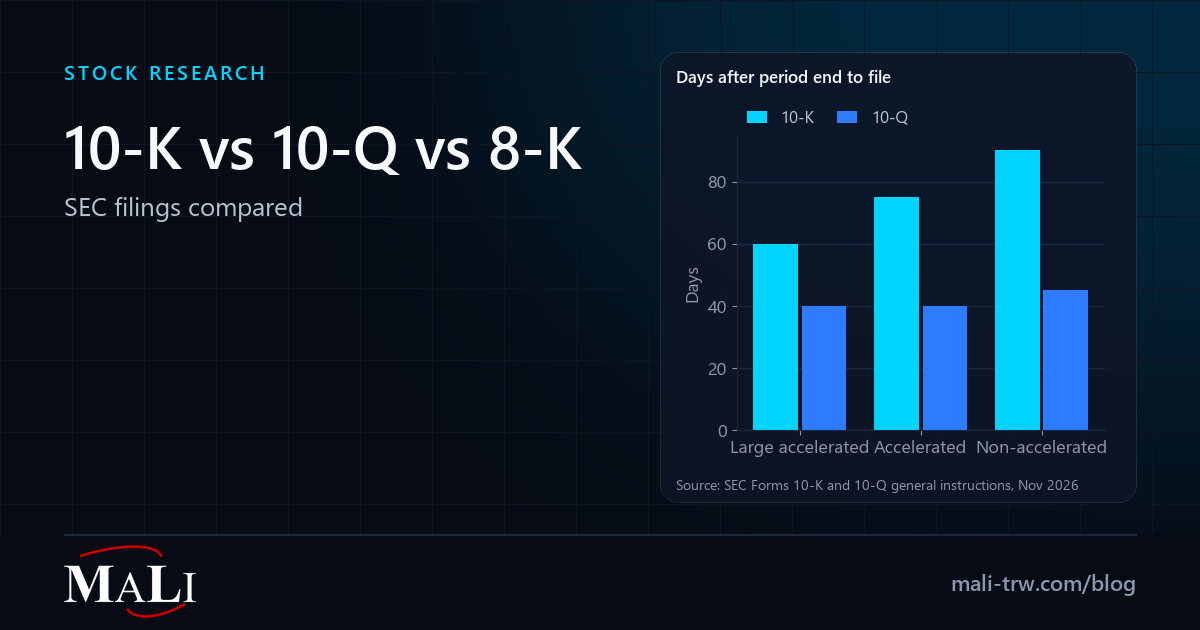
| Deadline | 60, 75 or 90 days after year end, by filer size | 40 or 45 days after quarter end | Generally four business days after the event |
| Financial statements | Audited | Reviewed by the auditor, not audited | Only if the event requires them |
| Best for | The full business, risks, multi-year trends | What changed this quarter | Breaking developments |
The 10-K: the full annual picture
The 10-K is the most complete document a company files. It covers the business, risk factors, management's discussion and analysis (MD&A), and the audited financial statements with their notes. Because an independent auditor has audited the statements, it's the most reliable source of a company's numbers.
Large accelerated filers (broadly, companies with a public float of $700 million or more) must file within 60 days of fiscal year end, accelerated filers within 75 days, and other companies within 90 days.
Read the 10-K when you're forming a view on a company for the first time, or once a year to check whether your view still holds. The guide on how to read a 10-K walks through the five sections that matter most.
The 10-Q: the quarterly update
Companies file a 10-Q for each of the first three fiscal quarters. There is no 10-Q for the fourth quarter, because the 10-K covers the full year. Large accelerated and accelerated filers have 40 days after quarter end; other companies have 45.
A 10-Q is shorter than a 10-K. It contains condensed financial statements, an MD&A for the quarter and year to date, and updates on risk factors and legal proceedings. The statements are reviewed by the auditor rather than audited, which is a less thorough procedure.
What a 10-Q is good for:
- Spotting change early. Margins, receivables, inventory and debt show up three months after the quarter, not up to a year later.
- Updated risk factors. Companies must disclose material changes to the risk factors in their last 10-K.
- Year-to-date cash flow. The cash flow statement in a 10-Q is cumulative for the year, so the third-quarter 10-Q covers nine months. To get a single quarter, subtract the previous year-to-date figure.
Because there's no fourth-quarter 10-Q, fourth-quarter figures are usually calculated as the full year from the 10-K minus the first three quarters.
The 8-K: material events as they happen
An 8-K reports specific events that shareholders should know about promptly. For most items, the company must file within four business days of the event. The form lists the reportable events by item number. Some of the most useful:
- Item 1.01: entry into a material definitive agreement.
- Item 2.01: completion of an acquisition or disposition of assets.
- Item 2.02: results of operations and financial condition. Most companies furnish their earnings press release under this item, as Exhibit 99.1.
- Item 4.01: a change in the company's auditor.
- Item 4.02: non-reliance on previously issued financial statements, which signals a likely restatement.
- Item 5.02: departure or appointment of directors and certain officers.
- Item 7.01 and 8.01: Regulation FD disclosures and other events the company chooses to report.
An 8-K can be a single page. Read the item number first; it tells you what kind of event it is before you read a word of the text.
Which filing answers which question
| Your question | Start with |
|---|---|
| What does this company do, and how does it make money? | 10-K, Item 1 |
| What are the main risks? | 10-K, Item 1A, then risk updates in later 10-Qs |
| Did margins hold up last quarter? | Latest 10-Q |
| What did the company report on earnings day? | 8-K, Item 2.02 and Exhibit 99.1 |
| Did the CFO just leave? | 8-K, Item 5.02 |
| Did the company change auditors or restate results? | 8-K, Items 4.01 and 4.02 |
| How much debt matures in the next five years? | 10-K debt note |
Other filings worth knowing
- Form 4: a change in holdings by a director, officer or 10% owner, filed within two business days of the trade.
- Schedule 13D and 13G: ownership of more than 5% of a class of shares, with 13D used by holders who may seek to influence the company.
- Form 13F: quarterly long holdings of institutional investment managers with at least $100 million in qualifying securities.
- DEF 14A (proxy statement): executive pay, board nominees and shareholder votes.
- S-1: registration statement for a new share offering, including IPOs.
A worked example: one quarter, three filings
Imagine a hypothetical retailer with a calendar fiscal year (the sequence is illustrative). In late April it reports first-quarter results. That day it files an 8-K under Item 2.02 with its earnings release attached. A few days later it files its first-quarter 10-Q with the condensed statements and MD&A. In June its CFO resigns, and an 8-K under Item 5.02 follows within four business days. In early March of the next year, it files the 10-K for the full year.
If you only read press releases, you'd see the earnings headline. The 10-Q tells you whether inventory rose faster than sales, and the 10-K tells you whether the risk factors changed after the CFO left.
Where MALI fits
MALI's SEC financials feature reads the statements in each 10-K and 10-Q and links every figure to the filing it came from, so you can move from a number to its source in one click. Fourth-quarter figures are derived from the 10-K and marked as derived. The public stock financials pages do the same for 108 large US companies.
To hear about new filings without checking EDGAR, event alerts can notify you when a company files an 8-K, 10-Q, 10-K, 13D or 13G. Restated figures replace the originals in MALI's tables, so for a point-in-time history, read the original filings.
FAQ
Is a 10-Q audited?
No. The financial statements in a 10-Q are reviewed by the company's independent auditor, which is a more limited procedure than an audit. Only the annual statements in the 10-K are audited.
Why is there no 10-Q for the fourth quarter?
Because the 10-K covers the whole fiscal year. Fourth-quarter figures are usually calculated by subtracting the first three quarters, from the 10-Qs, from the annual totals in the 10-K.
How quickly must a company file an 8-K?
For most reportable events, within four business days. Some items, such as certain Regulation FD disclosures, have different timing.
Where are earnings releases filed?
Most companies furnish their earnings press release on Form 8-K under Item 2.02, usually as Exhibit 99.1, on the day they announce results.
Sources
- Form 10-K, Investor.gov (SEC)
- Form 10-Q, Investor.gov (SEC)
- Form 8-K, Investor.gov (SEC)
- Form 8-K general instructions and items, SEC
- Accelerated filer and large accelerated filer definitions, SEC
This article is educational and is not investment advice. MALI is a research and analytics platform; it does not recommend buying or selling any security.