
How Much to Invest Monthly to Reach a Goal
By MALI ·
To work out how much to invest each month to reach a goal, take the target amount, subtract what your current savings would grow to by the target date at an assumed return, and divide the gap by the future value of $1 a month over the same period. In formula form, the monthly amount is (target − savings × (1 + r)^n) × r / ((1 + r)^n − 1), where r is the monthly return and n the number of months. The answer depends heavily on the assumed return, so work it out for several returns, not just one.
This article walks through the calculation, as part of portfolio management for self-directed investors. The returns used are assumptions for the arithmetic, not forecasts of what any investment will earn.
Goal-based investing in one paragraph
Goal-based investing starts from what the money is for: a house deposit in five years, college in twelve, retirement in thirty. Each goal gets its own target, date and risk level. Sanjiv Das, Harry Markowitz, Jonathan Scheid and Meir Statman (2010) formalized this "mental accounts" approach, with risk defined in each account as the probability of failing to reach its threshold, and showed how it can be reconciled with mean-variance portfolio theory. Investor.gov's guide to asset allocation makes the practical point that the right mix depends largely on your time horizon and your ability to tolerate risk, both of which differ by goal.
The inputs
- Target amount. What you need, and in which dollars: today's or the future's (see inflation below).
- Date. The number of months until you need it.
- What you already have set aside for this goal.
- An assumed annual return, after fees. Try a range.
- Contribution timing. The formula here assumes deposits at the end of each month.
Convert the annual return to a monthly one: r = (1 + annual return)^(1/12) − 1. This gives exactly the annual return when compounded for twelve months. (Dividing the annual rate by 12 is a common shortcut that slightly overstates it.)
The formula
Future value of current savings: FV_savings = savings × (1 + r)^n
Gap to fill: gap = target − FV_savings
Monthly amount: PMT = gap × r / ((1 + r)^n − 1)
The term ((1 + r)^n − 1) / r is the future value of $1 deposited every month for n months. If the assumed return is zero, it's simply n, and the monthly amount is the gap divided by the number of months.
A worked example
In this illustrative example, a hypothetical investor wants $250,000 in 15 years (180 months) and has $20,000 set aside. They assume a 5% annual return after fees.
Step 1: the monthly rate. r = 1.05^(1/12) − 1 = 0.0040741, or about 0.407% a month.
Step 2: grow the existing savings. (1 + r)^180 = 1.05^15 = 2.07893. So $20,000 grows to $20,000 × 2.07893 = $41,579.
Step 3: the gap. $250,000 − $41,579 = $208,421.
Step 4: the future value of $1 a month. (2.07893 − 1) / 0.0040741 = 264.82. Each $1 deposited monthly for 15 years would grow to about $264.82 in total at this rate.
Step 5: the monthly amount. $208,421 / 264.82 = $787 a month.
Over 15 years that's $787 × 180 = $141,660 of contributions. The rest of the $250,000 comes from the $20,000 starting balance and assumed growth.
How much the assumption matters
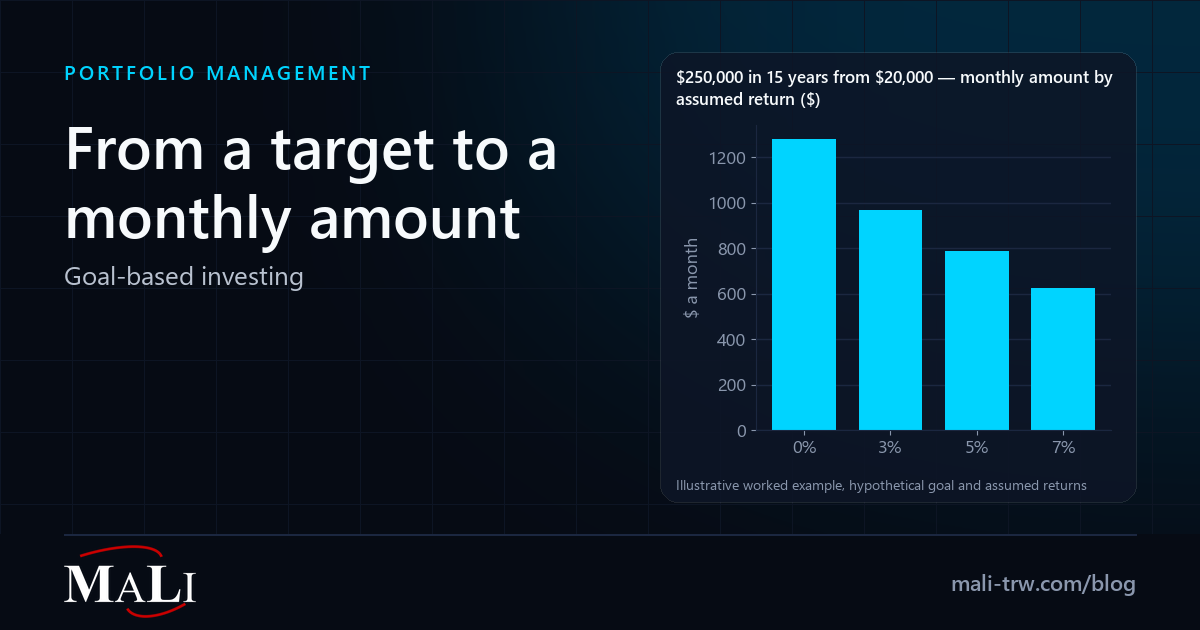
The same goal at other assumed returns (the chart):
| Assumed annual return | $20,000 grows to | Monthly amount needed |
|---|---|---|
| 0% | $20,000 | $1,278 |
| 3% | $31,159 | $967 |
| 5% | $41,579 | $787 |
| 7% | $55,181 | $626 |
Going from 3% to 7% cuts the monthly amount by about a third. That's why choosing the return assumption is the most consequential step, and why it's safer to plan on a modest one and treat anything better as a margin.
In today's dollars
A $250,000 target set in today's money needs more future dollars. At 2.5% inflation a year, $250,000 today is about $250,000 × 1.025^15 = $362,075 in 15 years. The simpler route is to plan in today's dollars using a real return: (1.05 / 1.025) − 1 = 2.44% a year. On that basis the monthly amount is about $1,022 in today's dollars, and you raise it each year with inflation.
Turning the number into a plan
- Match the mix to the date. Money needed in two years can't sit through a large drawdown the way 30-year money can. Max drawdown and recovery time shows how long recoveries can take.
- Automate the contribution on payday, so the plan doesn't depend on remembering.
- Use contributions to rebalance. Direct each month's money to whichever asset is below target. Calendar vs threshold rebalancing covers the rules.
- Re-run the numbers once a year. Replace the assumed growth with the actual balance and recompute the monthly amount for the time left.
- Run it pessimistically too. Recalculate with a lower return and a bad first few years. A plan that still works then is sturdier than one that needs the average to arrive on time.
Common mistakes
- Using a single return. One number hides the range of outcomes. Use at least three.
- Forgetting fees. A 1% annual fee lowers the return you should plug in by about a point.
- Mixing nominal and real. A target in today's dollars needs a real return; a nominal target needs a nominal return.
- Ignoring taxes. Taxable accounts lose some growth to tax each year; retirement accounts have their own rules.
- Treating the result as a promise. Returns arrive unevenly. The formula tells you what's needed under an assumption, not what will happen.
Where MALI fits
MALI doesn't calculate the monthly amount for a goal; use the formula above or the SEC's compound interest calculator on Investor.gov. What MALI's Portfolio Advisor does is the next step: in its Auto-Invest view you pick one of five goals, from capital preservation to aggressive growth, add new money, and get the trades that move your holdings toward that goal's mix. The goal mixes are a fixed policy rather than an optimizer, and nothing on it places an order.
The portfolio tracker keeps the actual balance you re-run the numbers from each year, built from your imported brokerage history.
FAQ
How do I calculate how much to save each month for a goal?
Grow your current savings to the target date at an assumed return, subtract that from the target, and divide the gap by the future value of $1 a month over the period: ((1 + r)^n − 1) / r with a monthly rate r.
What return should I assume?
There's no right number, and no tool can know it in advance. Use a range of assumptions, after fees, and plan on a modest one. For a goal set in today's dollars, use a return after inflation.
Should I invest monthly or in a lump sum?
That depends on whether you have the lump sum. Goal planning usually assumes regular contributions because that's how most people save. Investing regularly also spreads purchases over time, which some investors find easier to stick with.
How often should I update the plan?
Once a year is common, and after any large change in income, expenses or the goal itself. Use your actual balance and recompute the monthly amount for the time left.
What if I can't afford the monthly amount?
You have three levers: a later date, a smaller target, or a larger starting amount. Each changes the formula's inputs, so recompute rather than guess. Reaching for a higher assumed return to make the number fit doesn't change what markets deliver; it only makes the plan less likely to work.
Sources
- Compound Interest Calculator, Investor.gov (SEC)
- Beginners' Guide to Asset Allocation, Diversification, and Rebalancing, Investor.gov
- Das, Markowitz, Scheid and Statman, "Portfolio Optimization with Mental Accounts", Journal of Financial and Quantitative Analysis, 2010
This article is educational and is not investment advice. MALI is a research and analytics platform; it does not recommend buying or selling any security.